
Another brilliant couple of days down in Brighton for brightonSEO and MeasureFest, and this time I spoke on both of them. On Thursday I gave my MeasureFest talk on how Claude Code transformed my reporting and delivery for AI search and SEO, and on Friday morning I joined Tom Capper and Jade Faulconbridge for The Great Attribution Crisis panel. You can see my other talks and where I’m speaking next.
In between, I spent most of my time in MeasureFest and the main auditorium, and came away with a phone full of slides. I’ve stuck to what was on those slides, plus the themes from my notes where there weren’t any, rather than quoting anyone from memory, and linked each session so you can go to the source.
If there was one thread running through the two days, it was measurement. How do you measure visibility in answers that change every time you ask? How do you attribute revenue when more of the journey happens where analytics can’t see it? And how do you get budget signed off when the honest answer is “it depends”?
The exhibition hall asked the same question. Eighteen months ago, at brightonSEO in April 2025, I counted two stalls offering AI search measurement. This time I counted well over 12 before I gave up, and I’d put it at around two thirds of the stalls.
That’s very telling about where the industry is heading. Brands want to know whether ChatGPT, Gemini, Perplexity and Google’s AI results are recommending them, and the market has moved fast to tell them. The talks were more useful on the harder part, which is what those numbers mean and what to do about them.
Tracking AI visibility isn’t like tracking rankings
The most practical session I saw on this was George Pritchard of 11content on the do’s and don’ts of prompt tracking, which wasn’t on the published schedule but was on the MeasureFest board on the day.
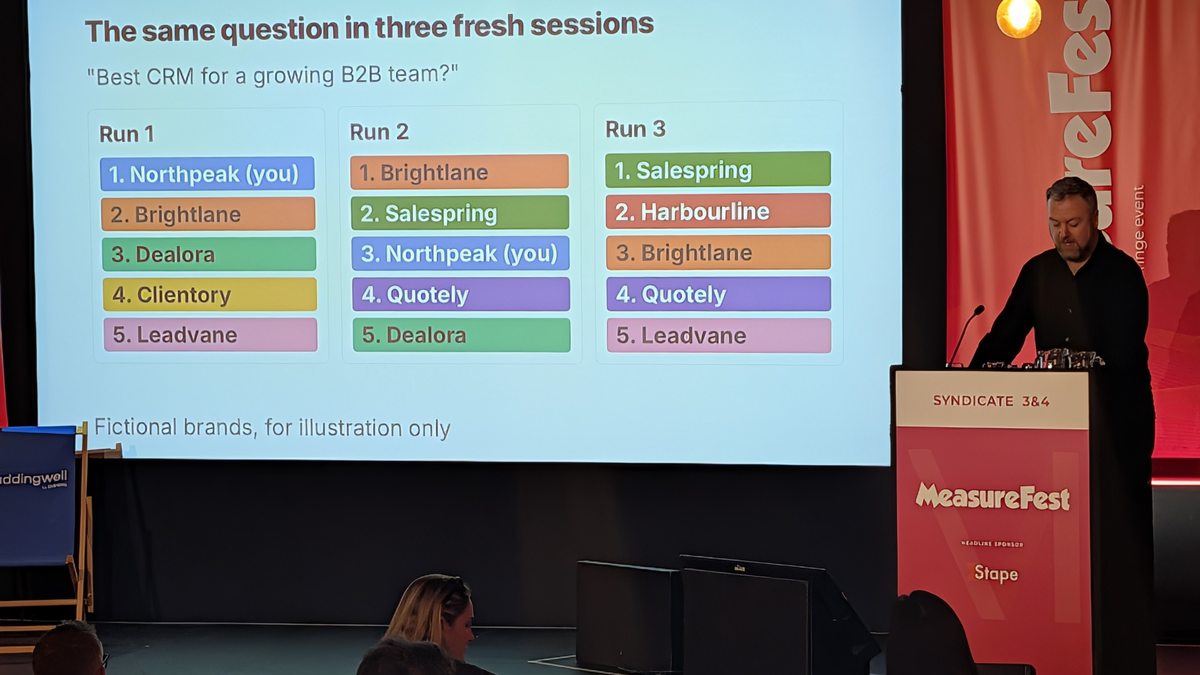
His starting point was that AI answers change every time you ask. Run the same prompt in three fresh sessions and the brands, and their order, move around. Ask three engines the same question and they cite different pages. So a single check of a single prompt tells you very little, in the same way a poll of 50 people tells you far less than a poll of 1,000.
His answer was to ask “how often do we appear?” rather than “where do we rank?”, run prompts many times, learn your normal range before you react to a movement, and track slower signals such as brand mentions, branded search and AI referrals alongside the prompts.
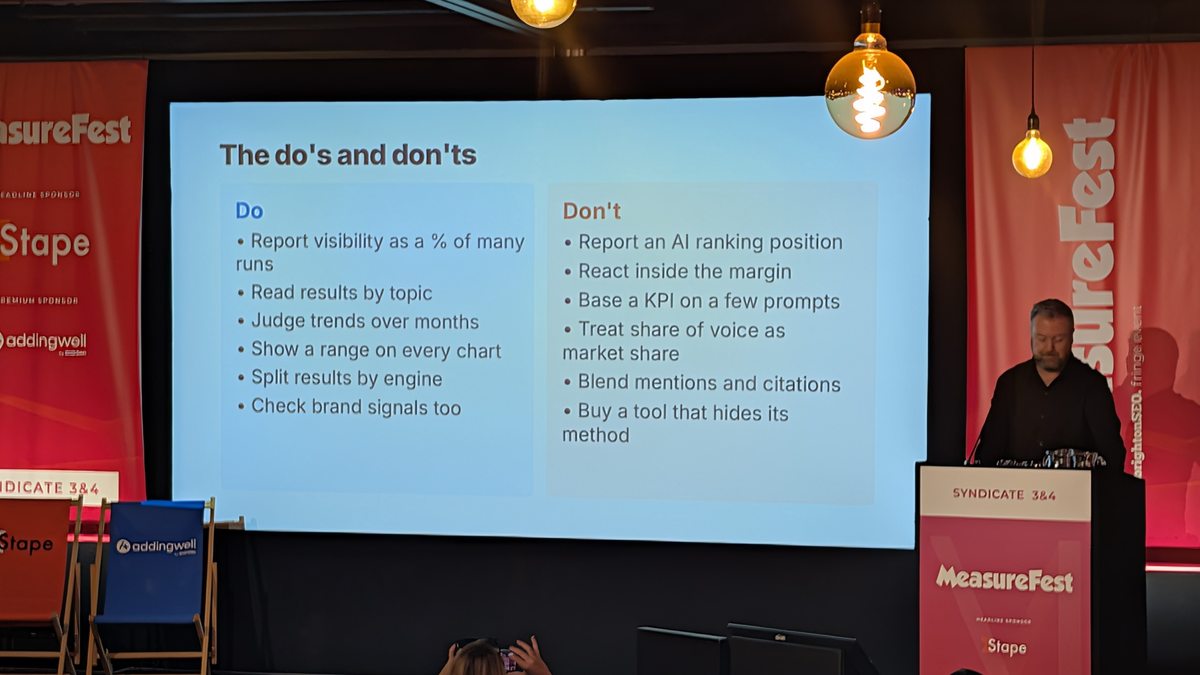
The do’s and don’ts slide is one I’d pin above any AI visibility dashboard. Report visibility as a percentage of many runs, read results by topic, judge trends over months, show a range on every chart and split results by engine. Don’t report an AI ranking position, react inside the margin, base a KPI on a few prompts, treat share of voice as market share or buy a tool that hides its method. His closing line summed it up: report the climate, not the weather.
Tom Capper’s MeasureFest talk, How not to measure AI, came at it from the other side.
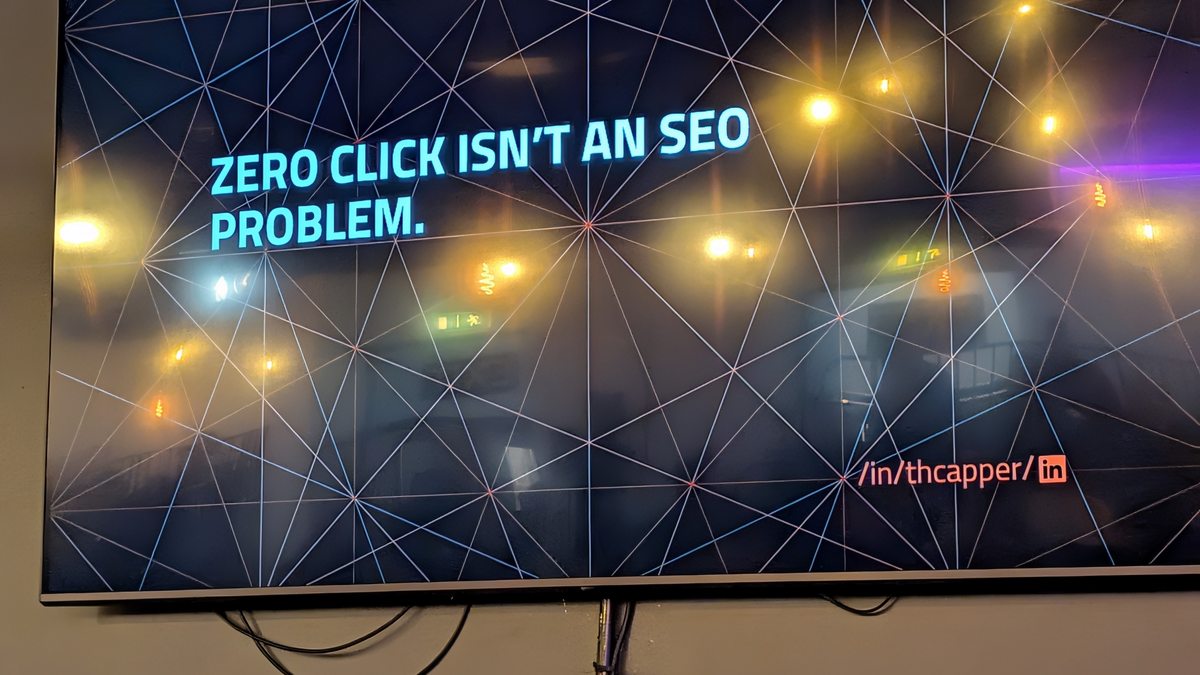
Zero click, he argued, isn’t an SEO problem. Channels don’t have to drive traffic to be valuable, but that still leaves us with a measurement problem, and he showed how often the #1 organic result isn’t even visible on screen. He also drew a clear line between a brand being mentioned in an AI answer and being cited as a source, which are two very different outcomes.
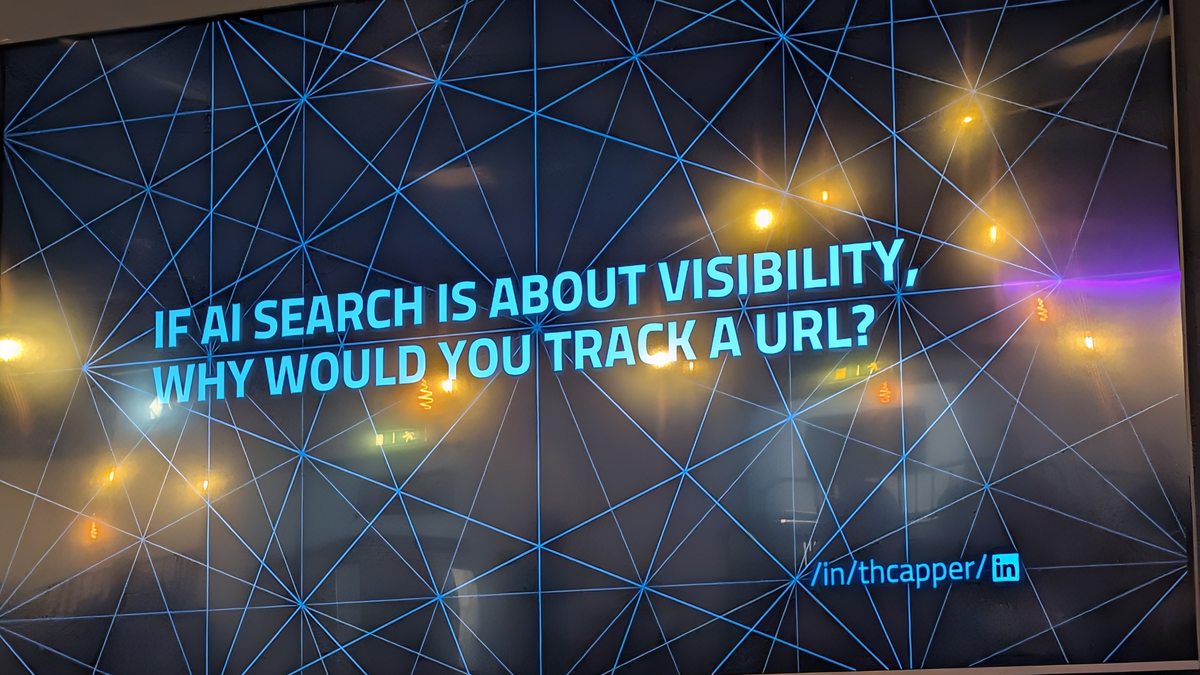
His question, if AI search is about visibility, why would you track a URL, is a good test for any AI visibility setup. Tracking whether a page gets cited is useful, but it’s the brand being named and recommended that drives the commercial outcome, so make sure your brand term tracking is comprehensive. I’ve written about that gap between being cited and being chosen in visible but not chosen.
Run AEO like a programme, and connect it to revenue
Samanyou Garg of Writesonic’s talk on building an answer engine optimisation (AEO) programme was one of my highlights of the first day, and the most operational talk I saw on AI search.
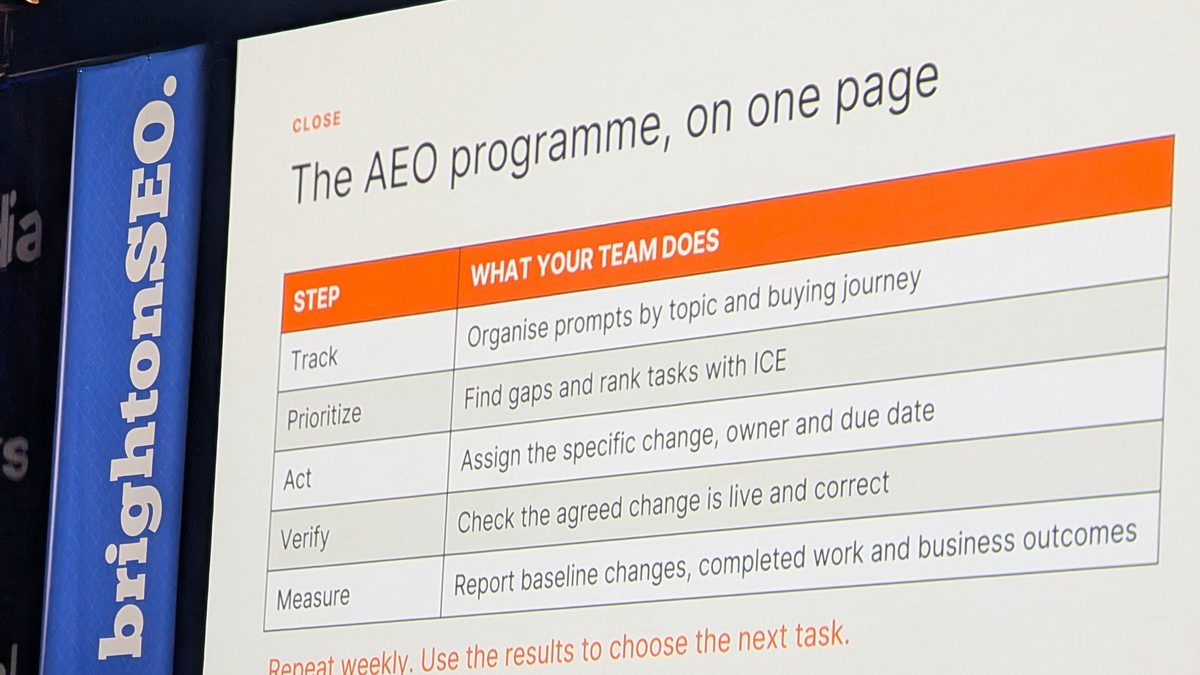
The framework fits on one page. Track, by organising prompts by topic and buying journey. Prioritise, by finding gaps and ranking tasks with ICE (impact, confidence and ease). Act, by assigning the specific change, an owner and a due date. Verify, by checking the agreed change is live and correct. Measure, by reporting baseline changes, completed work and business outcomes. Then repeat weekly and use the results to choose the next task.
A few details stood out. A 50% average visibility score can hide a 20% problem in one category. Customer questions come from Search Console, keyword tools, Reddit and forums, support channels, sales conversations and customer reviews, not from a prompt generator. And on the role of AI in the work itself: agents prepare, people approve.
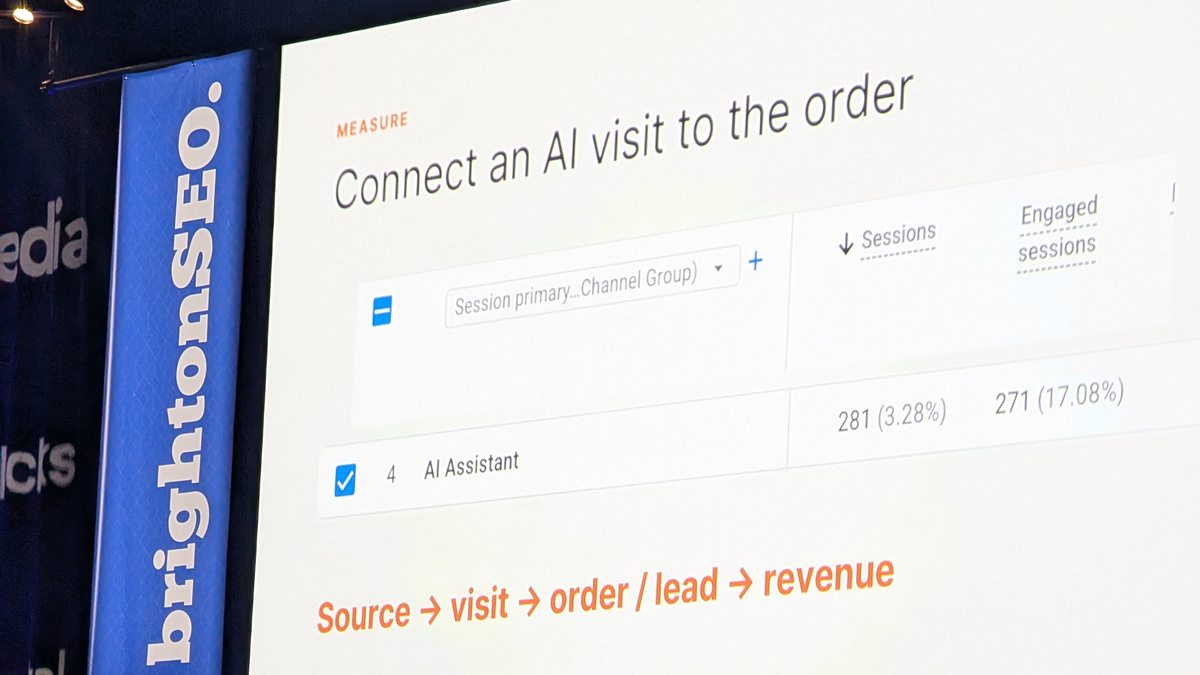
The measurement step went beyond visibility scores. Connect an AI visit to the order through a dedicated channel group in GA4, and ask customers where they first heard about you and what helped them decide. That last point is one I’d make to any brand. A free-text “How did you hear about us?” field picks up ChatGPT mentions that no analytics platform will ever record.
Information gain decides what earns a citation
Paris Childress of GEOforge on information gain made one of the clearest content arguments of the event.
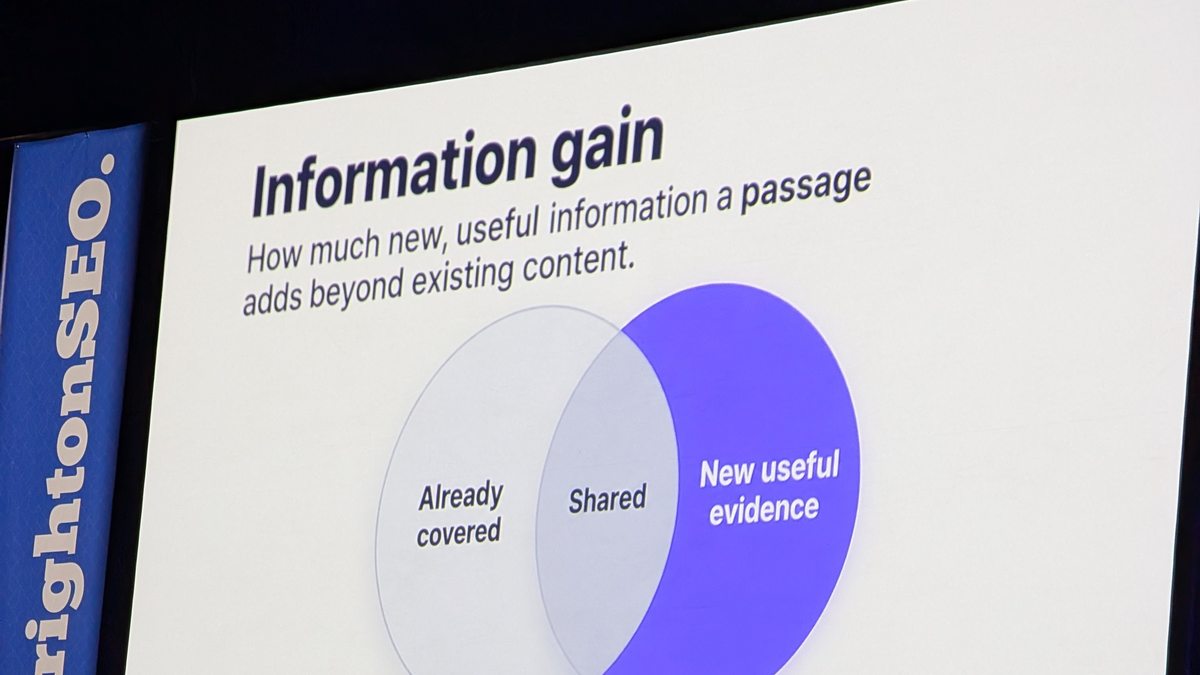
AI mostly feeds on public information, so content that repeats what’s already out there gives it nothing new to cite. Information gain is how much new, useful information a passage adds beyond existing content, and GEOforge scores it on a rubric that runs from common public knowledge up to highly proprietary insight. In their data, citation rates were highest in the top segment.
That’s the same conclusion I keep reaching from the other direction. Generic AI content is cheap to produce and easy to ignore, while original data, first-hand experience and real customer evidence give an AI system a reason to use you.
Jean Sarunporn’s talk on getting your brand recommended by AI agents came to a similar three-part answer.
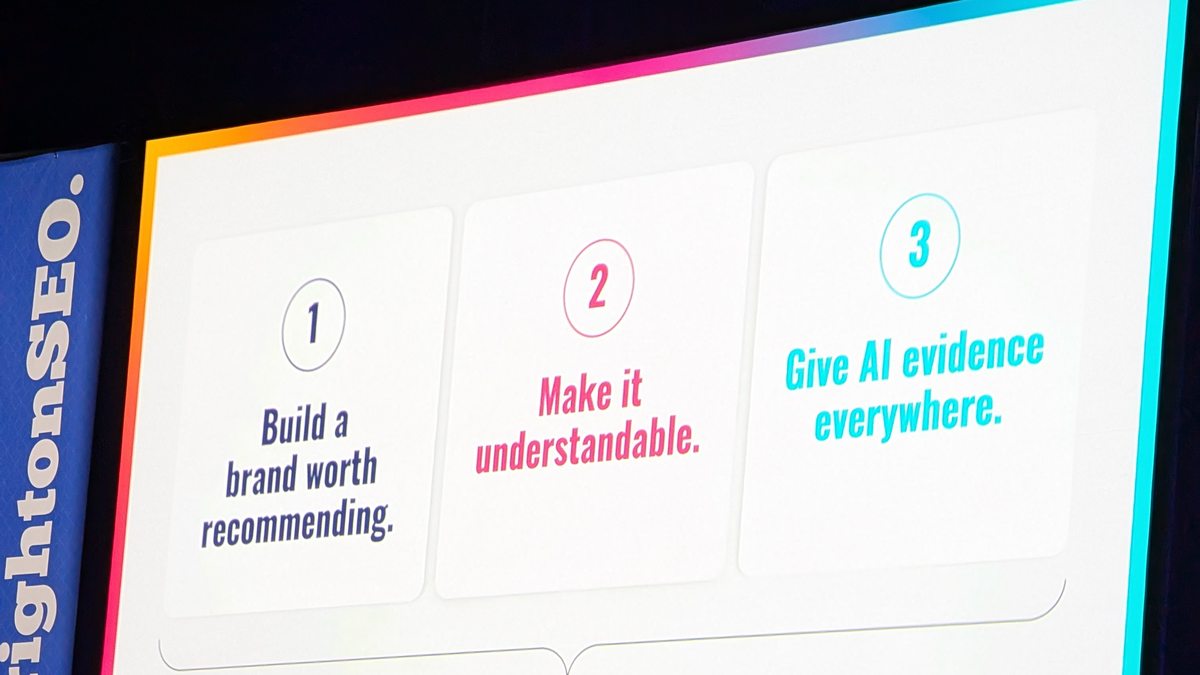
Build a brand worth recommending, make it understandable and give AI evidence everywhere. She also showed that two sources can both count as citations without having the same impact on the answer, and that the old marketing reflex to a complaint (“how do we respond to this?”) should give way to the product question (“what can we learn from this?”).
Own a lane, and earn the memory
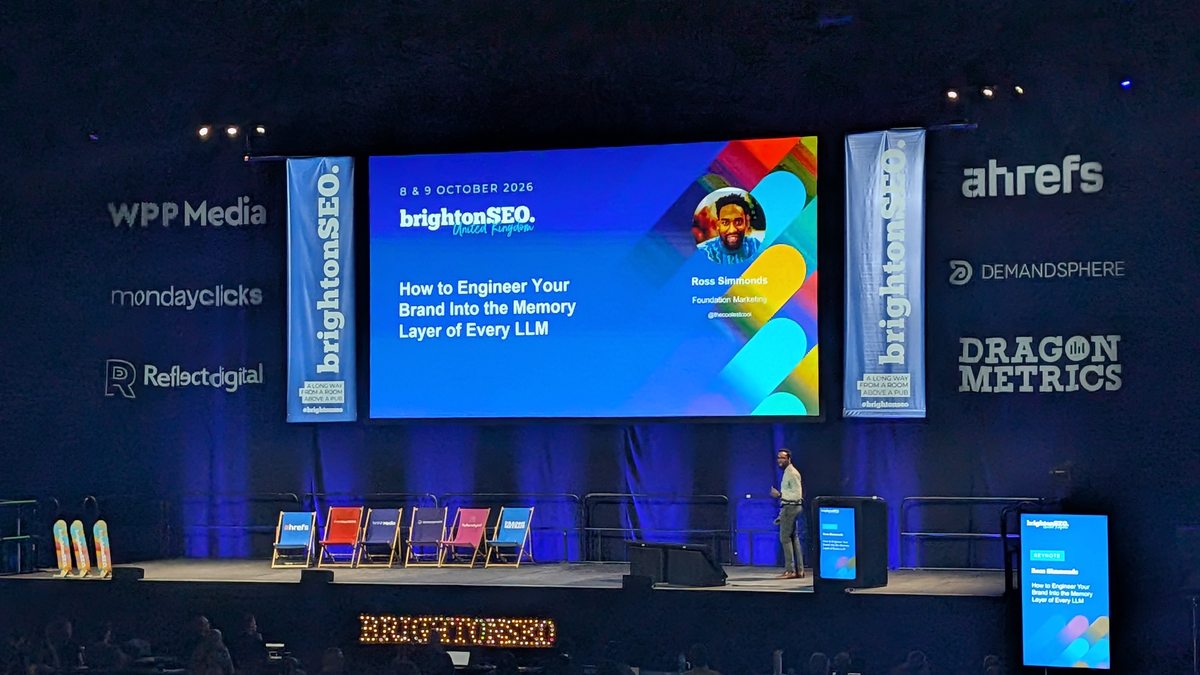
Ross Simmonds of Foundation closed Friday with the keynote on engineering your brand into the memory layer of every LLM.
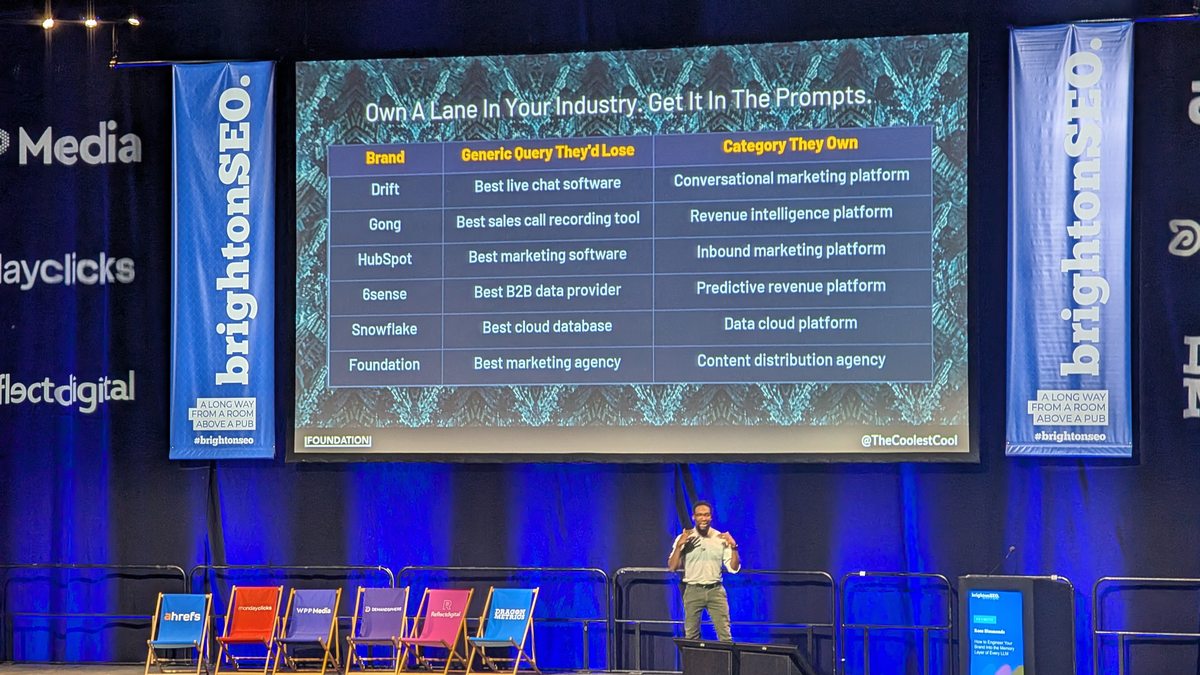
The slide that stuck with me most was “own a lane in your industry, get it in the prompts”. His examples set the generic query a brand would lose, such as “best marketing software”, against the category it owns, such as “inbound marketing platform” for HubSpot. For most brands, winning the broad category prompt isn’t realistic, but owning a well-defined lane is.
The way to own one is language. Coin the terms and frameworks for your category first, so that when buyers paste long, detailed prompts into an LLM describing their whole situation, the language they use and the answer they get back both point to you. Those long prompts are also where Reddit gets cited far more often than it does for short head terms.
He made the case that, right now, YouTube is mispriced attention. Videos are showing up for bottom-of-funnel searches (best-of, alternatives, comparison and demo queries) more than ever, yet most brands aren’t making them. His playbook was to find the commercial topics through keyword research, make the videos, cut them into Shorts, work with creators in your category and embed the videos on your own site.
On Reddit, his most practical advice was to check whether a subreddit with your brand’s name exists and claim it if it doesn’t, before someone else does, then build a community there around the bottom-of-funnel questions you’re already tracking in AI answers. And he drew a hard line on tactics.
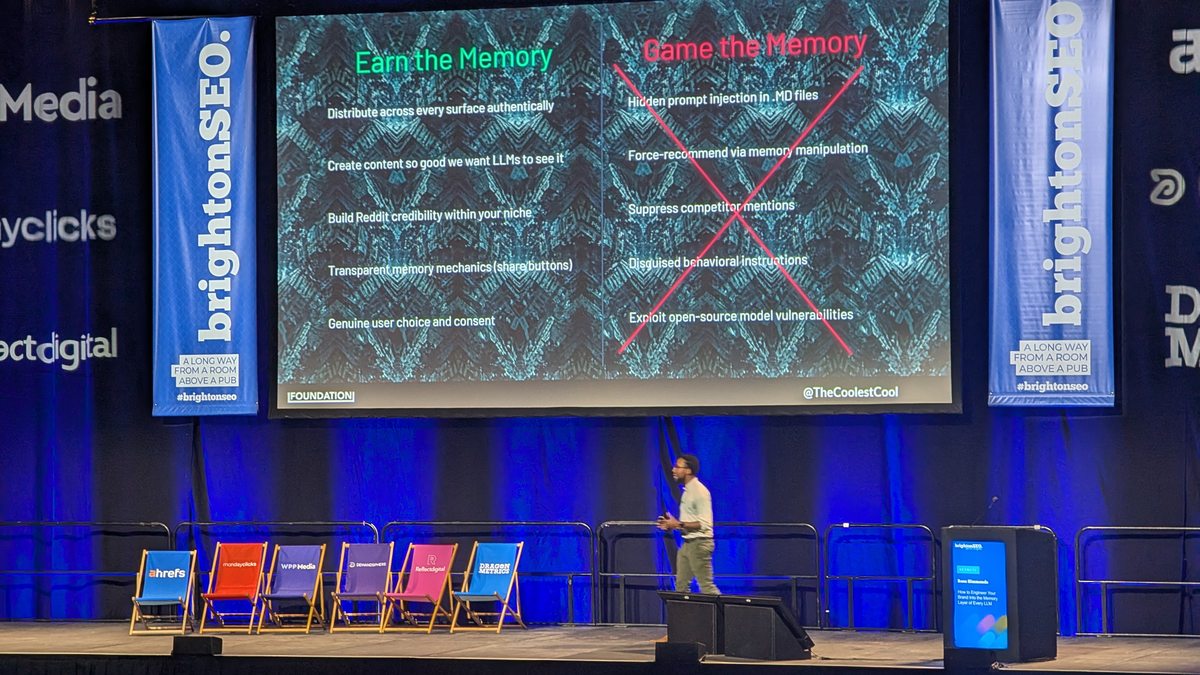
Earn the memory by distributing across every surface authentically, creating content good enough that you’d want an LLM to see it, building credibility within your niche on Reddit and being transparent about anything that asks a model to remember you. Don’t game it with hidden prompt injection, memory manipulation, suppressing competitor mentions or exploiting model vulnerabilities. His closing point was that marketers should ask whether they should do something, not only whether they can, which is a fair test for every AI search tactic doing the rounds.
Attribution needs redefining, not abandoning
This was the home ground for MeasureFest, and it ran straight into our panel on Friday.
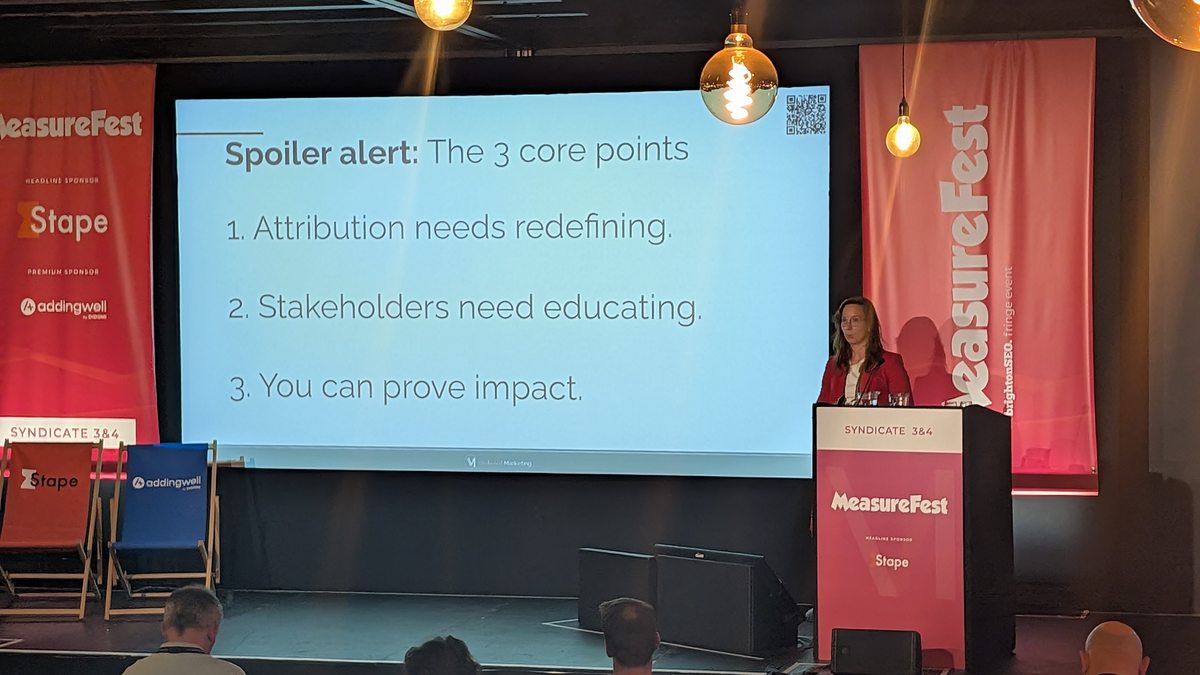
Jade Faulconbridge of Attributed Marketing, on attribution being dead and decision-making living on, put it in three points: attribution needs redefining, stakeholders need educating and you can still prove impact. Attribution as we know it isn’t dead so much as impossible, because the neat textbook funnel now runs through emails, social ads, offers, forums, reviews, display, TV, in-store visits, blogs and word of mouth that no single tool can stitch together.
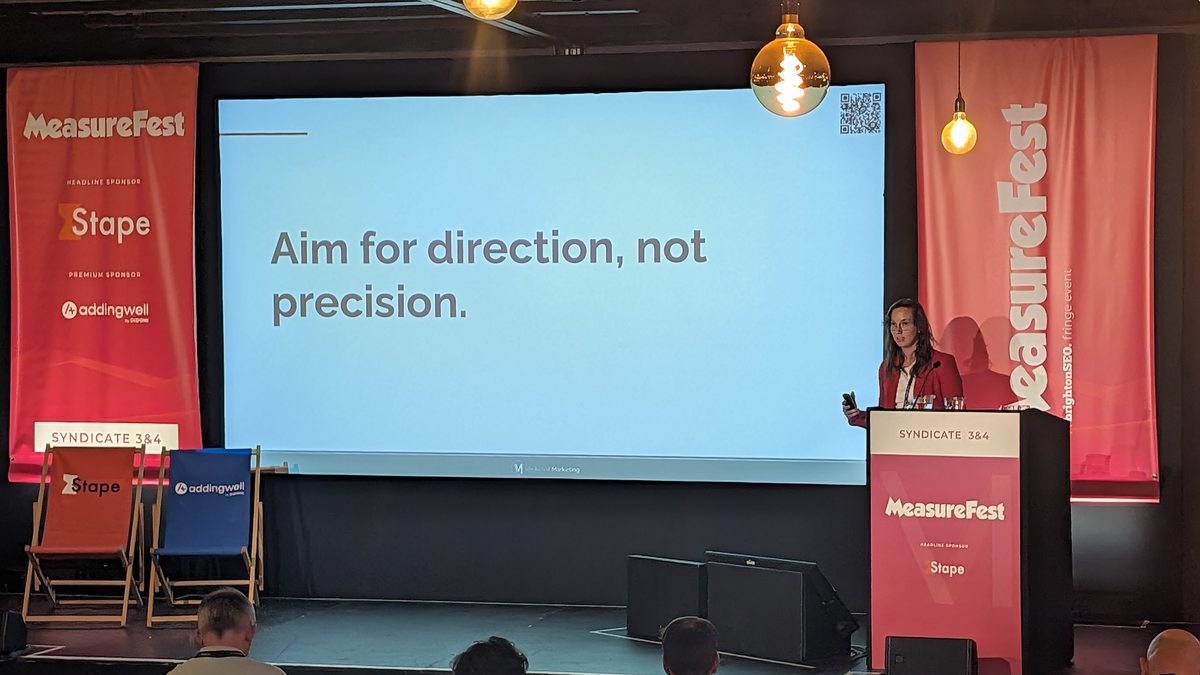
Her closing slide, aim for direction, not precision, is the advice I’d give any board that’s waiting for a perfect number before it makes a decision. It’s where I’d start with AI search measurement too: get a clear before picture, conversion tracking you can trust and a free-text discovery field, then get comfortable reporting direction rather than absolutes.
The foundations underneath attribution are shifting too. Ian Lewis of Launch Online on why server-side tracking changes everything compared browser and server-side tracking on cookie durability, ad blocker resistance, site performance and data governance, and pointed to Google Tag Gateway as where things are heading. It serves Google’s tags through your own domain as first-party requests, so fewer of them get blocked or cut short by ad blockers and browser privacy features.
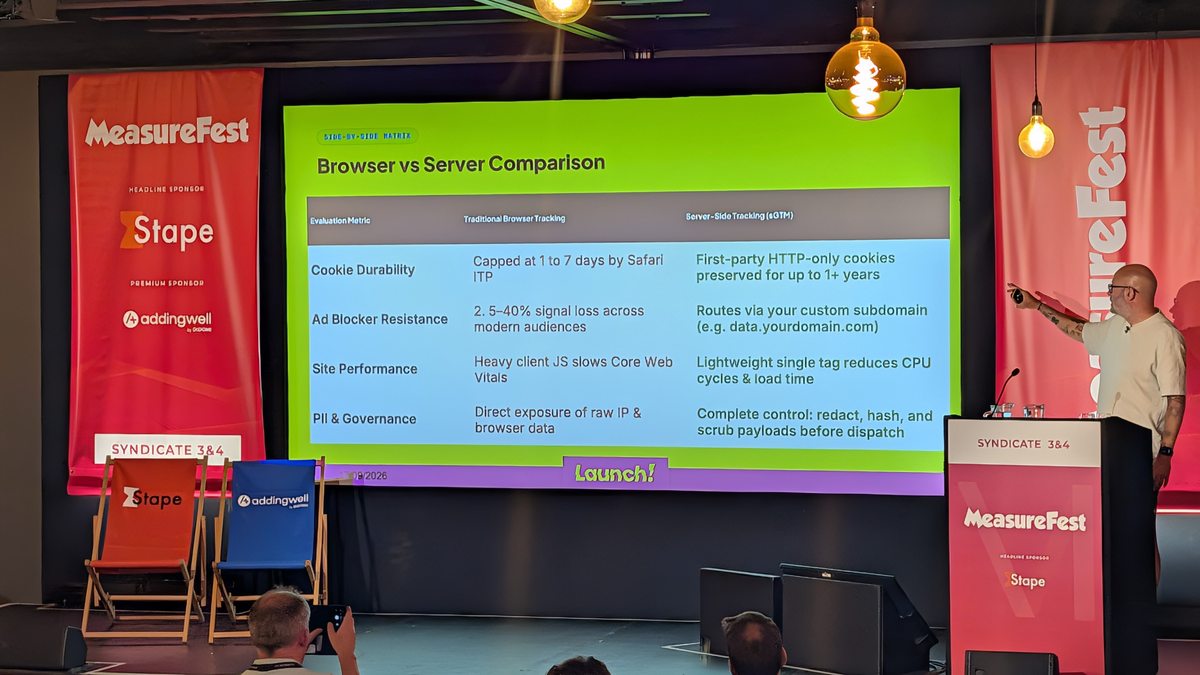
His lead-gen example recovered session and conversion data that wasn’t reaching GA4, improved Meta’s event match quality and sped up mobile load times, which is the kind of commercial case server-side tracking needs when it’s competing for budget.
Gavin Attard on the UK’s new consent law followed with the legal side.
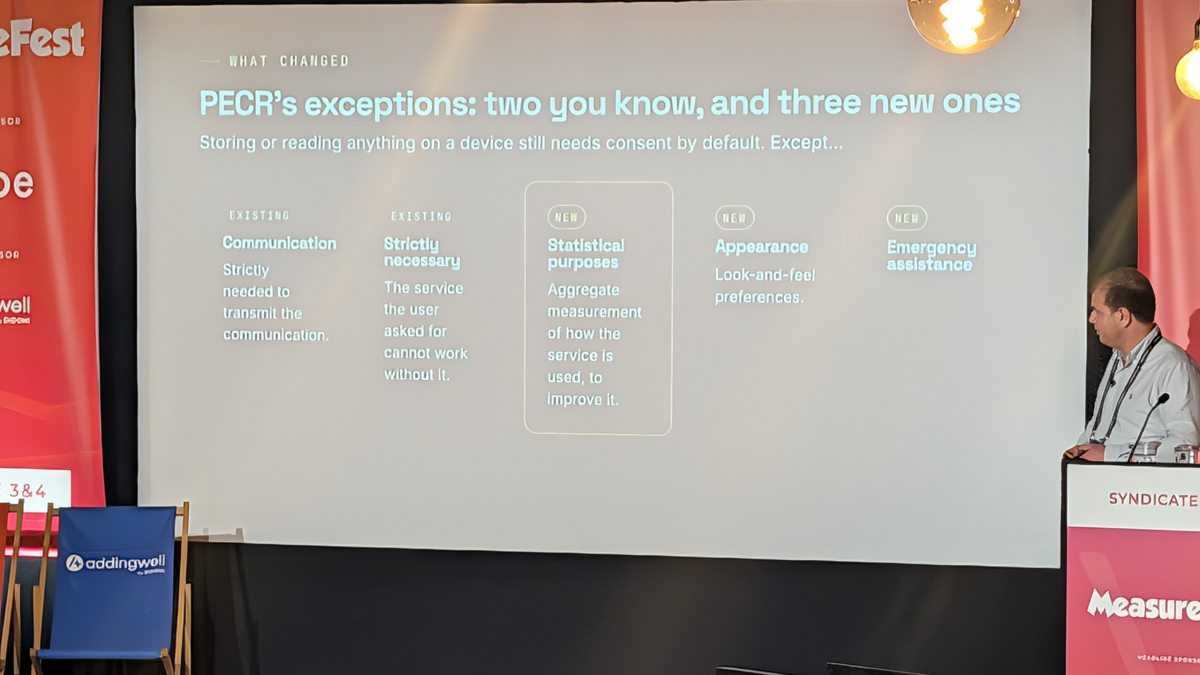
Storing or reading anything on a device still needs consent by default, but alongside the two exceptions most of us know (communication and strictly necessary), there are now three new ones, including aggregate measurement for statistical purposes. His model had three consent categories (exempt measurement under the statistical purposes exception, wider statistics and ads) plus an off switch for anyone who objects, which overrides everything, including the exempt category. If your consent setup still treats all analytics as optional, it’s worth a conversation with whoever owns your privacy compliance, because there may be more measurement available than you’re collecting.
Getting SEO budget signed off
David Matthew Vernon of Search Theory on getting SEO budget signed off was one of the most commercially useful talks of the two days.
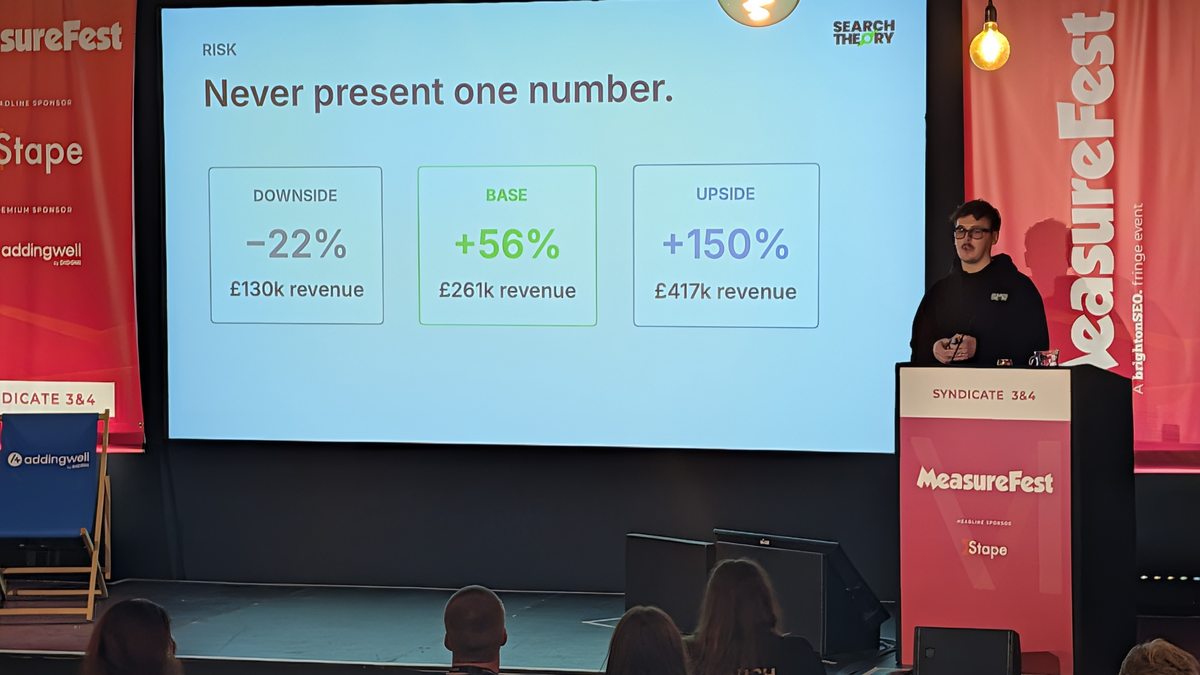
He opened on a frustration every SEO will recognise: a business that’ll approve another £50k of ad spend without blinking, then asks what exactly it gets back for £50k of SEO. His SEO forecasting model builds the investment case from five inputs: demand that already exists, the extra share of it SEO can realistically capture (not “position #1”), your own conversion rate from GA4 or CRM data rather than an industry benchmark, value and a ramp, because SEO takes time to build.
Then came the step most forecasts skip: revenue isn’t the finish line, because finance funds profit, cash and payback, so his illustrative £261k of forecast revenue became £117k of value at a 45% contribution margin. Present it as a range, with a downside, a base and an upside case, and put four numbers on the boardroom slide: the ask, the return, the payback month and the review month.
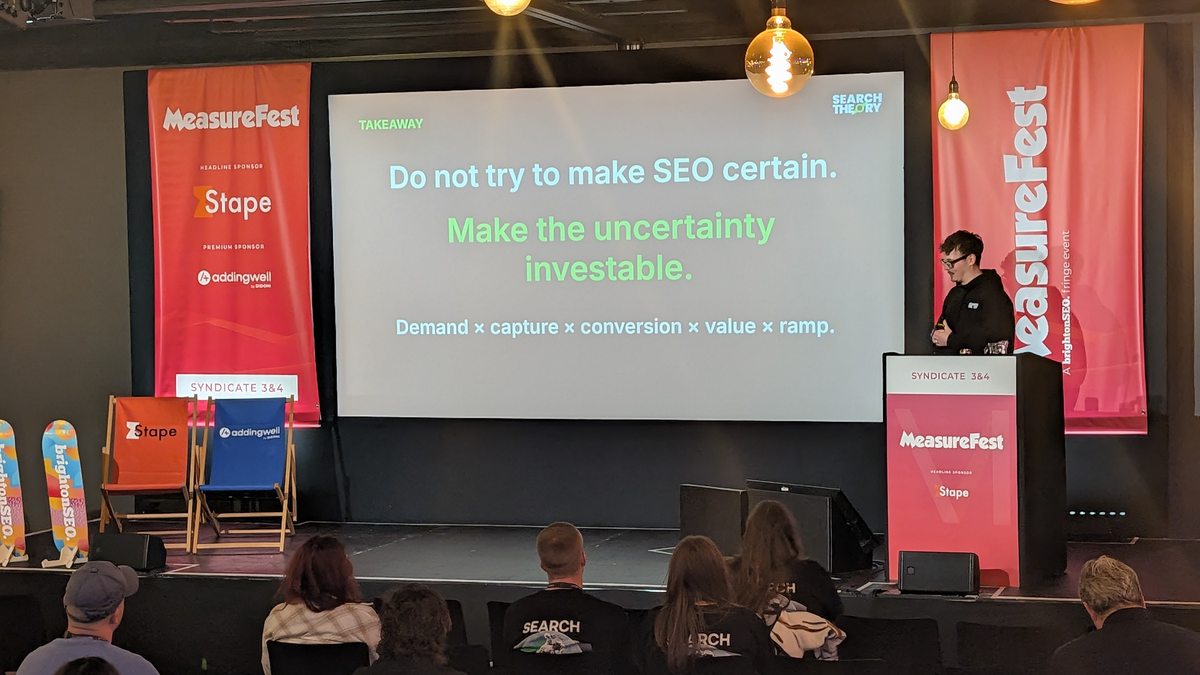
His takeaway was don’t try to make SEO certain, make the uncertainty investable. It’s the same principle I use when calculating SEO ROI, and it’s the right answer to the board that wants a guarantee nobody can honestly give.
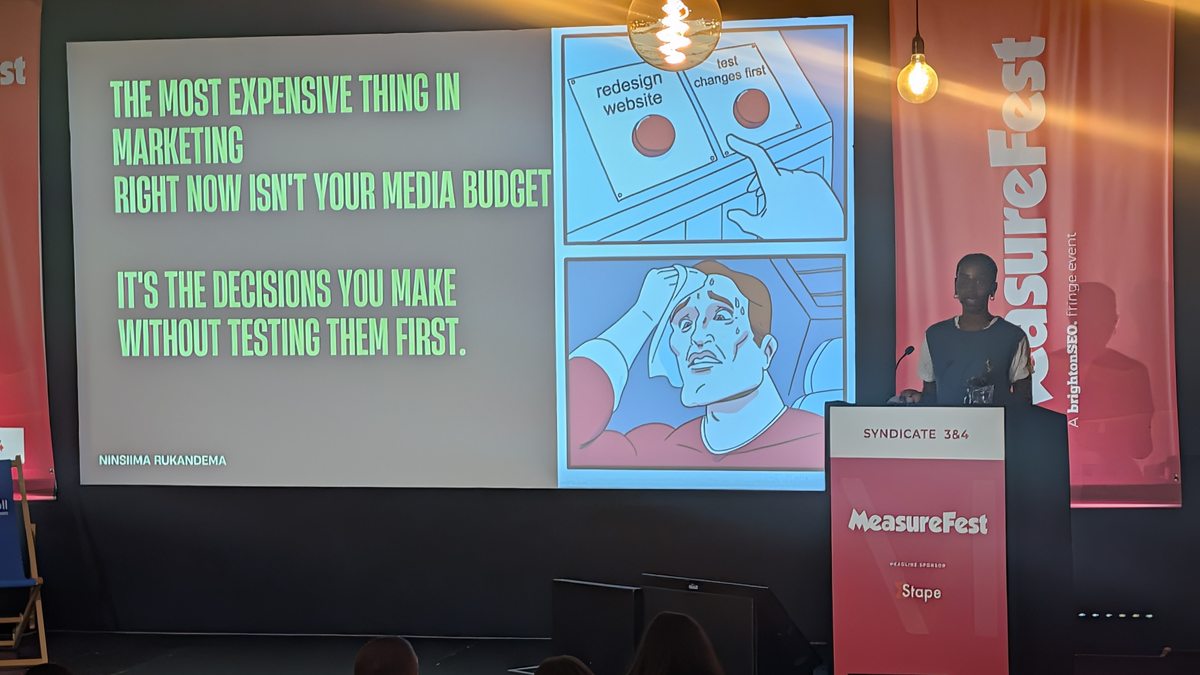
Two more MeasureFest talks on Friday afternoon made the commercial case from different angles. Ninsiima Rukandema on why experimentation isn’t optional in an era of budget scrutiny argued that the most expensive thing in marketing right now isn’t your media budget, but the decisions you make without testing them first, and showed what a full redesign launched without testing can do to conversion rates.
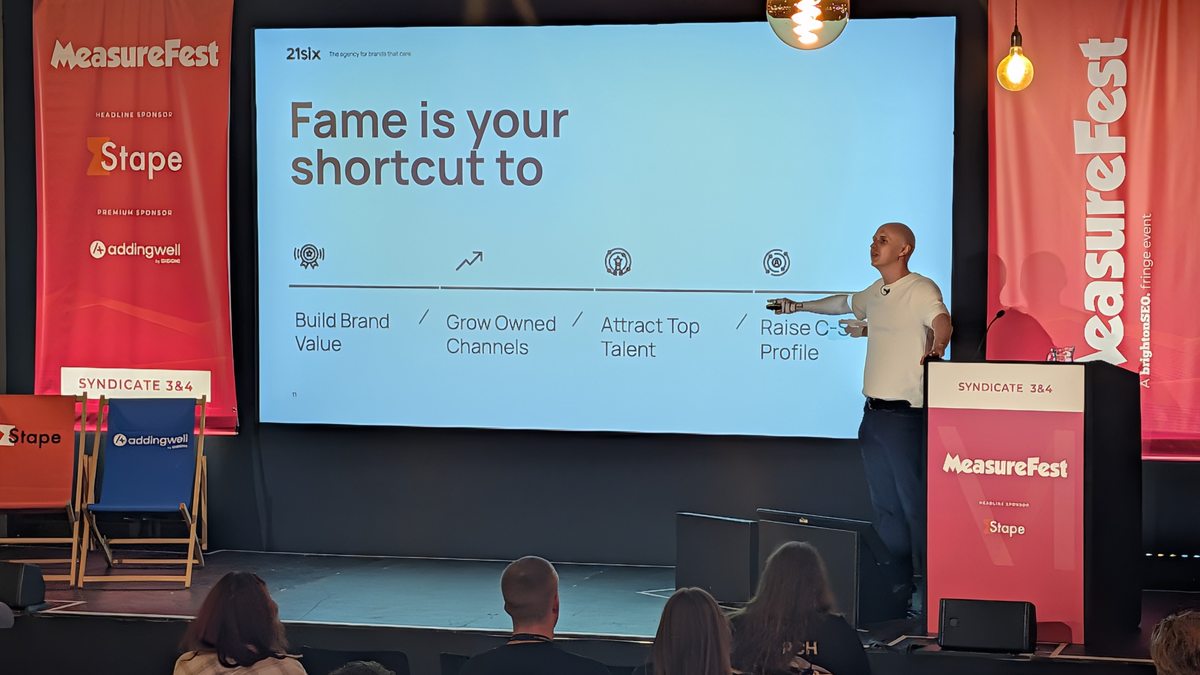
And Oliver Duffy-Lee of 21six on how B2B brands escape their industry and become famous made the case that audience leads back to authority, and that fame is a shortcut to building brand value, growing owned channels, attracting talent and raising profile.
Using AI responsibly
Amrdeep Athwal’s talk, AI: with great power comes great responsibility, was a timely counterweight to all the AI tooling in the hall.
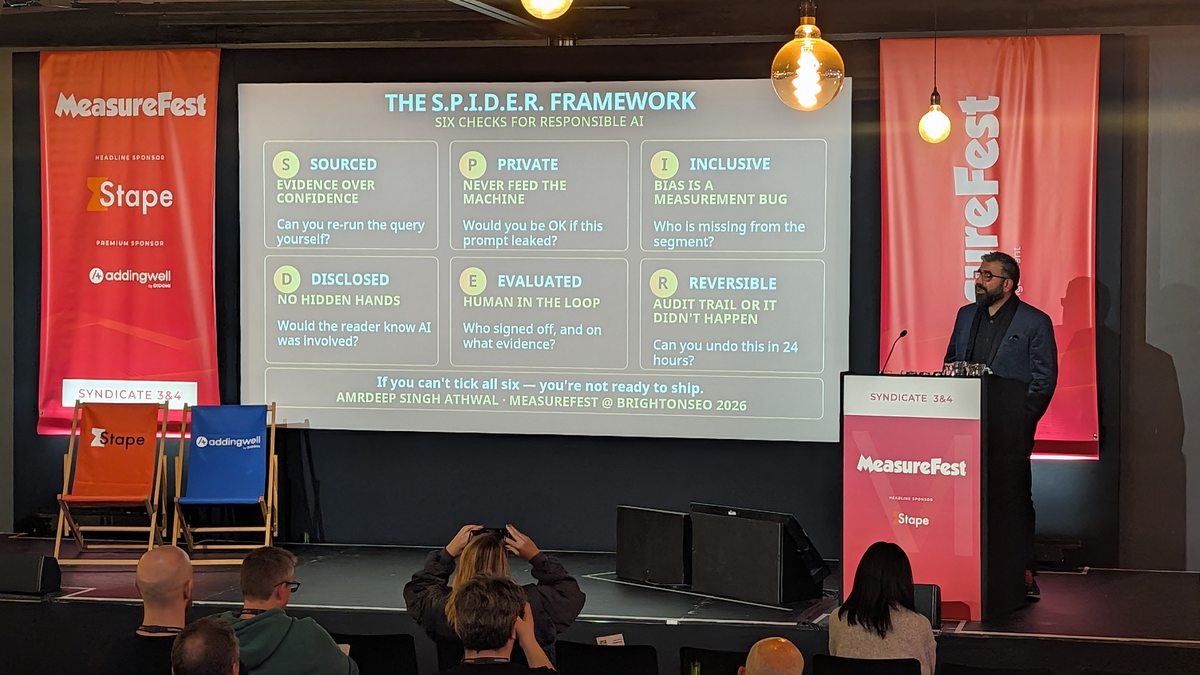
He walked through real cases where AI went wrong in public, from an airline chatbot that invented a bereavement fare policy a tribunal then made the airline honour, to a CV screening tool that had to be scrapped for bias. His S.P.I.D.E.R. framework turns that into six checks. Sourced: can you re-run the query yourself? Private: would you be OK if this prompt leaked? Inclusive: who’s missing from the segment? Disclosed: would the reader know AI was involved? Evaluated: who signed it off, and on what evidence? Reversible: can you undo it in 24 hours? If you can’t tick all six, you’re not ready to ship.
It’s a useful checklist alongside what I covered in my own talk, where the specialist stays accountable for every decision.
Reporting on the whole ecosystem
Peter Longton on moving from measuring search to measuring everything made the case for reporting search as part of a wider ecosystem: tracking product features across search platforms, tracking the conversations you want to be part of, and including social in your total ecosystem reporting so you can see how every digital asset contributes to your overall presence.
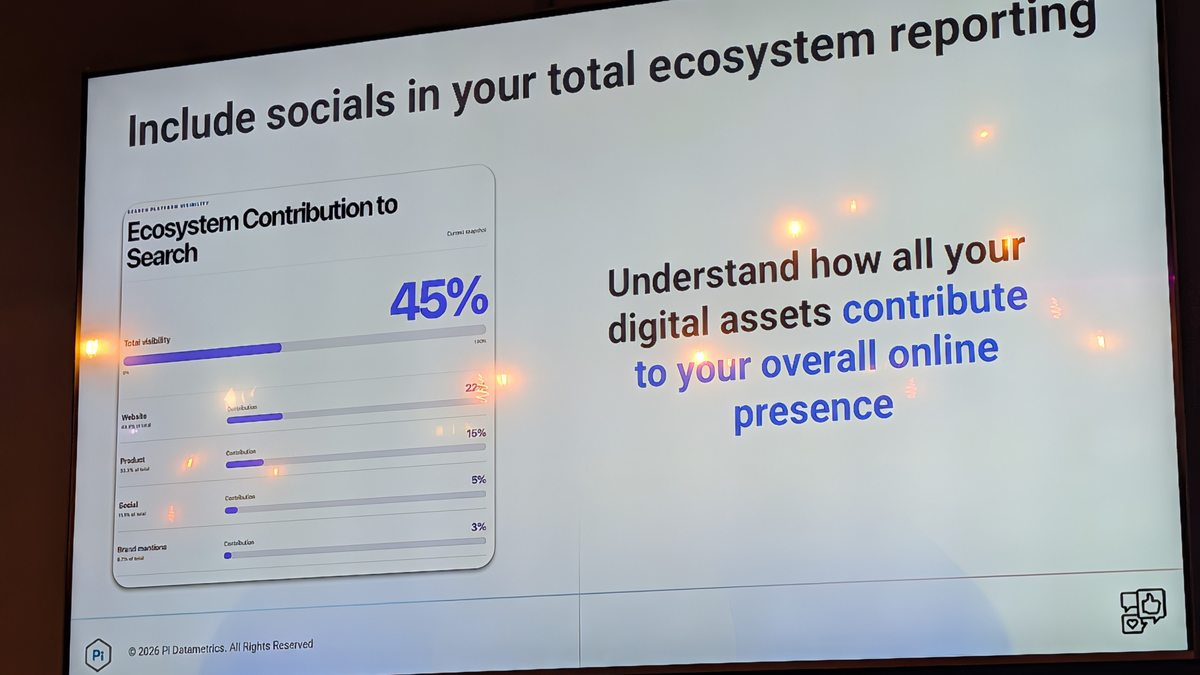
That fits where discovery has gone. People find brands through Google, check Reddit, compare options in ChatGPT and watch a YouTube review before they ever land on the site, so reporting that only looks at one channel will keep missing most of the story.
What will SEO teams look like in 2030?
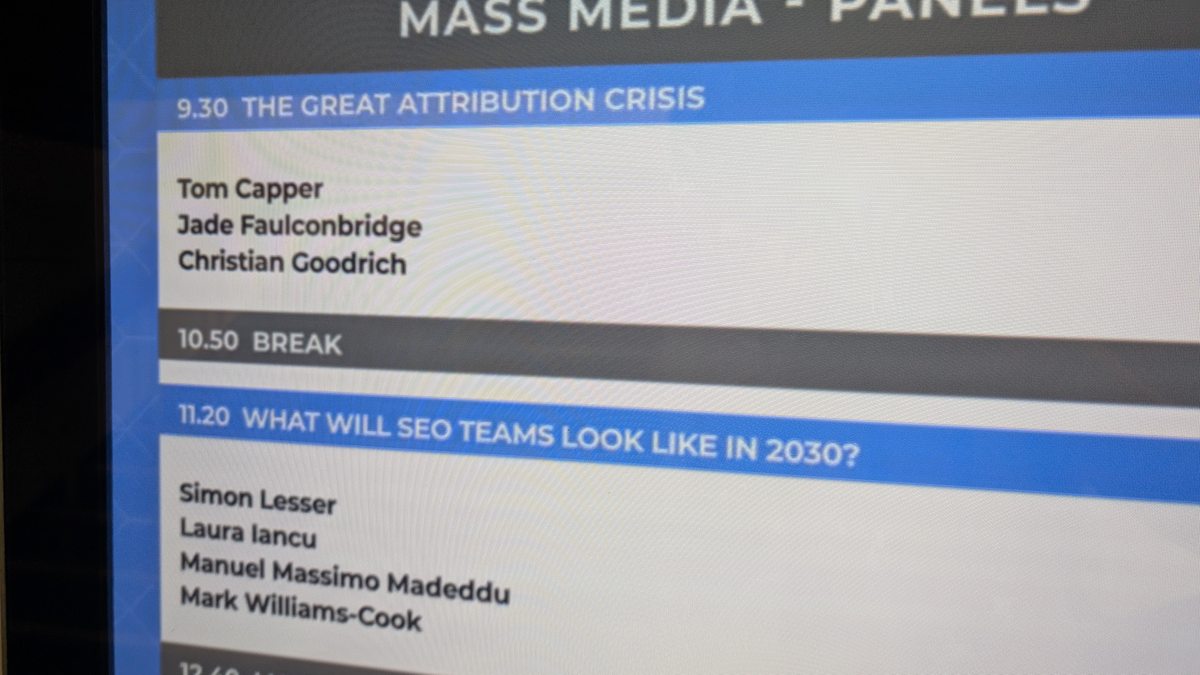
On Friday I also caught the 2030 SEO teams panel with Simon Lesser, Laura Iancu, Manuel Massimo Madeddu and Mark Williams-Cook.
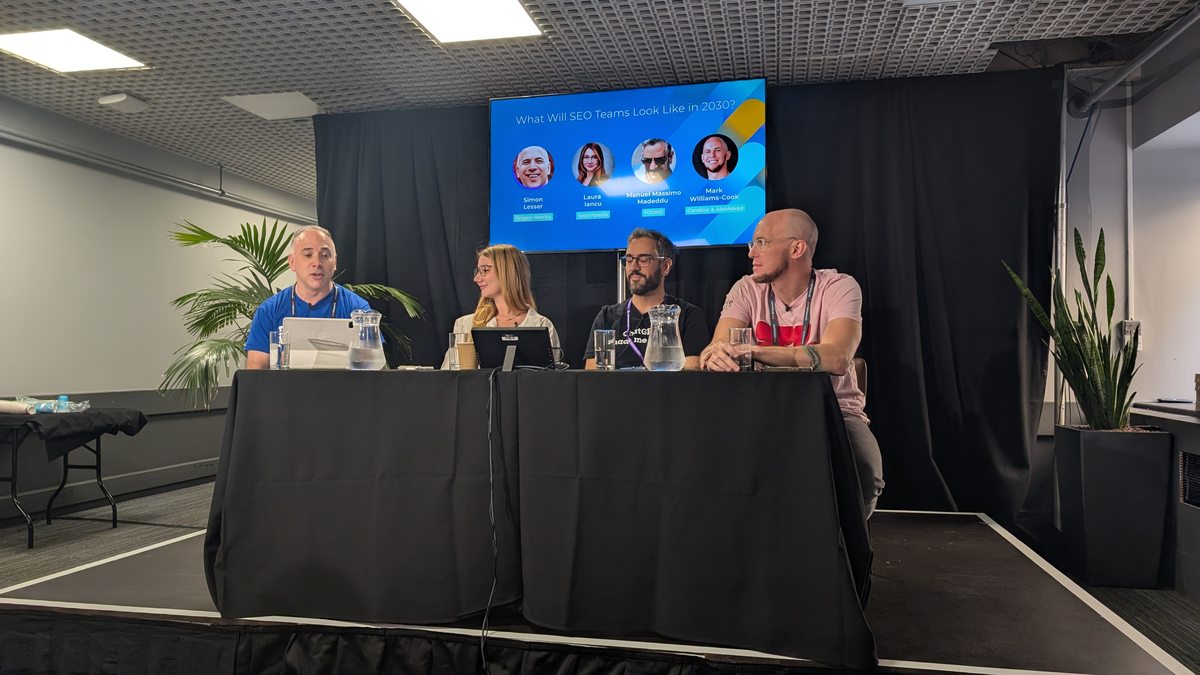
There were no slides on this one, so these are the themes from my notes rather than anyone’s exact words.
The conversation kept coming back to fundamentals. If AI takes over more of the work, the people who stand out will be the ones who understand how the systems work, from how search engines crawl, index, render and rank to where large language models have sharp edges. You can only judge AI output if you could have done the work yourself, and one example from the panel made the point well: a quickly built AI audit tool whose polished output had nothing actionable in it.
That raised a harder question about juniors. If entry-level work gets automated, how does the next generation build the experience that today’s senior people got by doing it the long way? There was no neat answer, but on hiring there was broad agreement: look for curiosity, research skills and critical thinking, and ask how someone reached an answer, not only whether it was right.
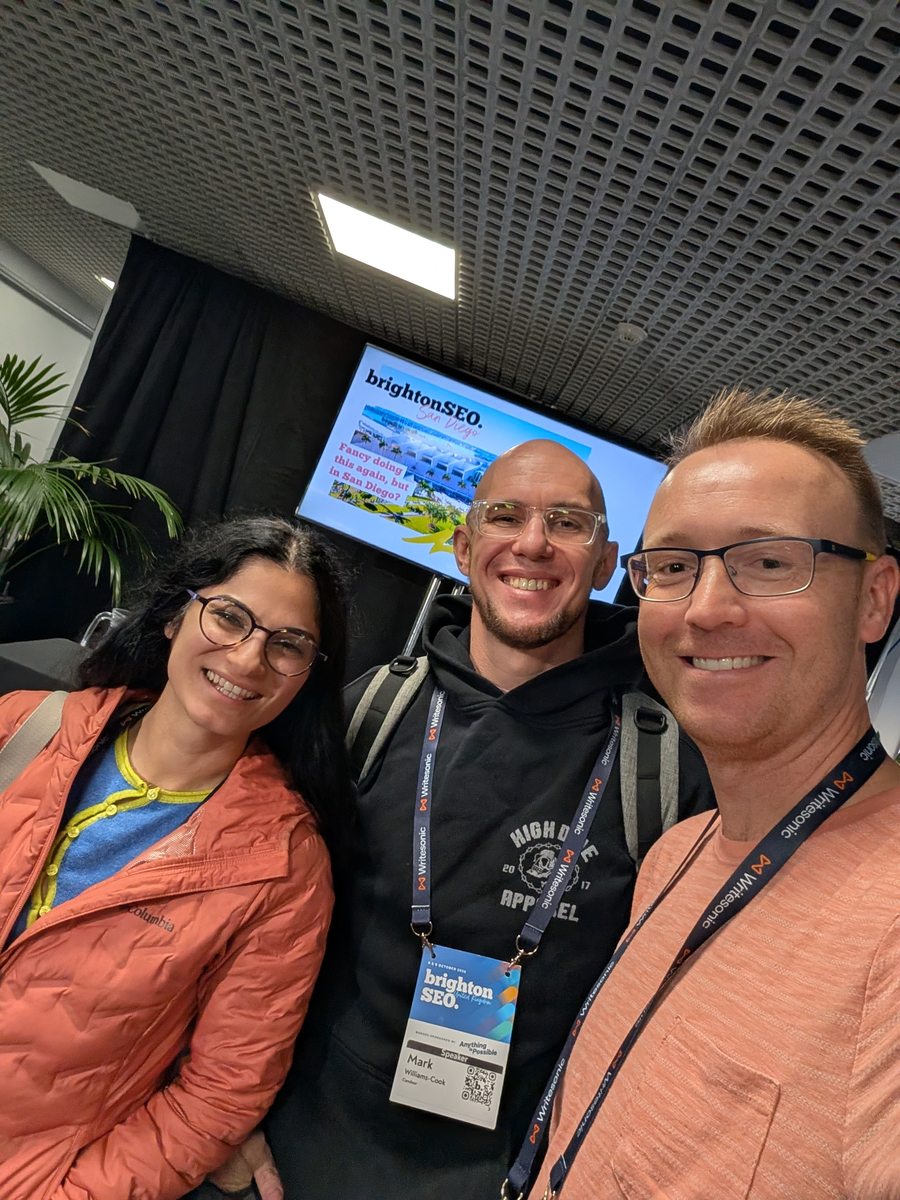
I asked the panel whether expecting SEO specialists to cover social, off-site signals and AI search, as well as rankings and technical work, risks diluting the specialism. The answer was that it’s consolidating rather than diluting. Most good SEOs are already T-shaped, and with agent-to-agent protocols and new technical standards on the way, the panel expected more technical SEO work rather than less, with SEO becoming more integrated with brand, engineering and the wider marketing team. I carried on that conversation with Mark Williams-Cook after the session.
There was optimism about tooling too. Internal tools built quickly with AI were welcomed, with the warning that running a tool for years is a very different job from building it, which is why commercial SEO platforms aren’t going anywhere.
It chimed with my own talk, where the specialist stays accountable for every decision, and with what I found when I counted how often I correct AI in practice.
My talk, and the attribution panel
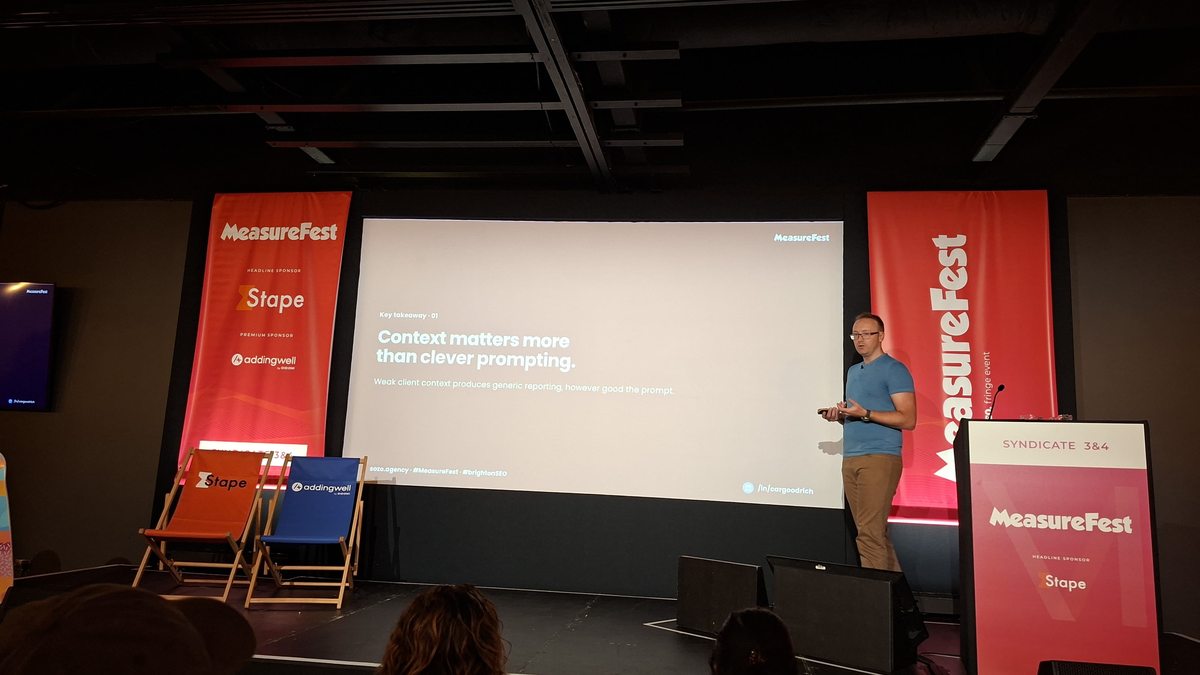
On Thursday I gave my MeasureFest talk on how Claude Code has changed the way I report on and deliver AI search and SEO. The Measurement and Reporting session was at capacity, with 300+ people in Syndicate 3 & 4 and a “track is now at capacity” sign on the door, which says a lot about how many teams are wrestling with the same problem.
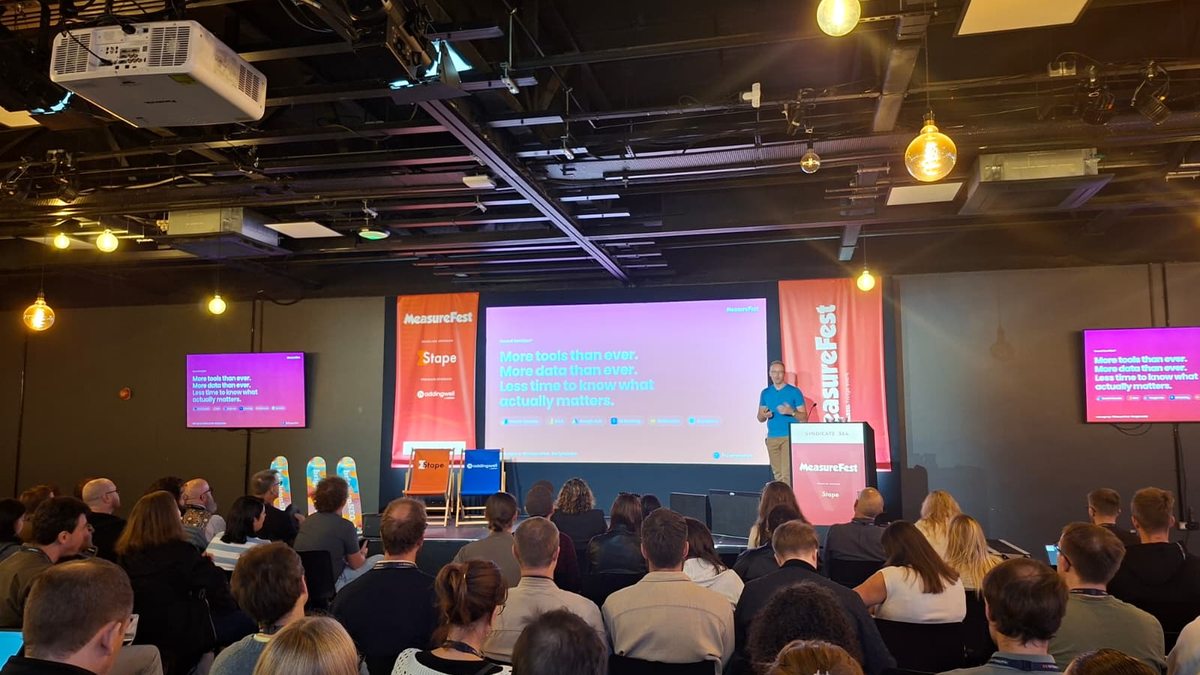
I showed five tools I’ve built with Claude Code at SOZO over the past six months, from a client context engine to an AI search auditor and a visibility tracker. They take the assembling off experienced people rather than replacing anyone, so more of their week goes on interpreting the numbers and advising on what to do next. The lessons I’d pass on to anyone building their own are to start from the friction, give the system context instead of clever prompts and keep a specialist accountable for every decision.
On Friday morning I was back on stage with Tom Capper and Jade Faulconbridge for The Great Attribution Crisis, a panel on how measurement reached this point, the workarounds we each use and how to handle stakeholders when the numbers no longer add up.
Old friends and new faces
For all the notes I took, what I value most about brightonSEO is the people. It’s full of brilliant people who share what they know and look out for one another, and I felt that warmth all the way through the two days. That positive culture is a big part of why I keep coming back, and I love the mix of it, between the talks I get to sit in on and the people I get to speak with.
Sharing so much of the conference with Wendy Boreham and Sarah Baker added to the experience too, from the little moments checking in with each other and having them in the audience during my talk, to meeting up for lunch and in the evenings.
It was a privilege to share the stage across both days with Tom Capper, Jade Faulconbridge, Kumar Amrendra, Jon Earnshaw and Peter Longton, and to have my usual catch-up with Samanyou Garg and the team at Writesonic, our AI search measurement partner at SOZO.
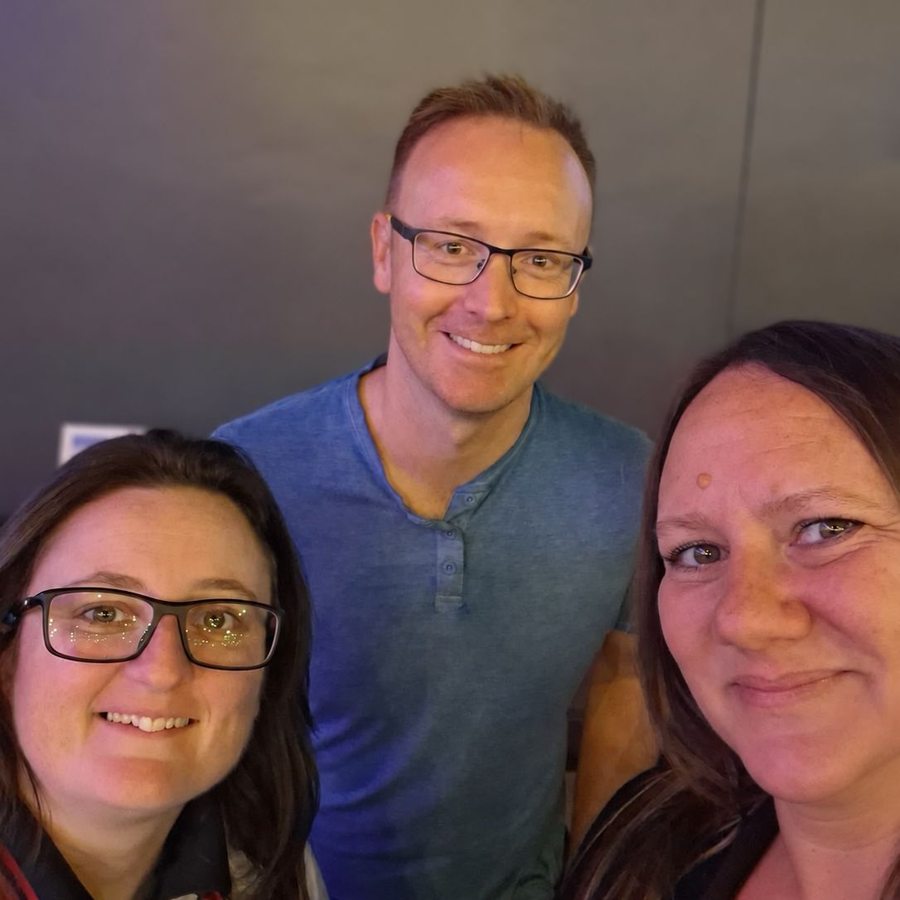
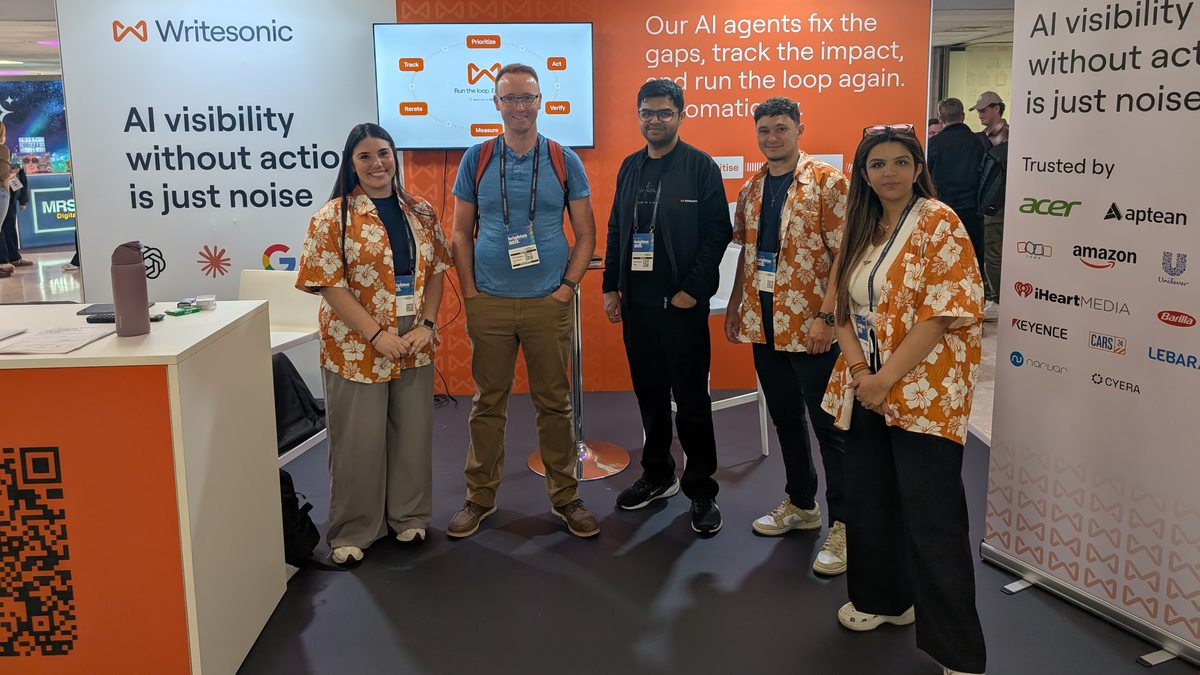
Some were old friends from previous brightonSEOs, some were brand new faces, and some I’d only ever known through LinkedIn comments and messages until last week. It’s funny how you can feel like you know someone well before you’ve ever shaken their hand. It was good to meet and chat with Amrdeep Athwal, Bengü Sarıca Dinçer, James Yorke, Joseph Bauermeister, Laura Iancu, Mark Williams-Cook, Sean Barber and Tyler Burbage too.
And if you don’t make any friends, the brightonSEO seagull will always keep you company.
Practical takeaways
- Stop reporting AI rankings. Report visibility as a share of many runs, by topic and by engine, with a range on every chart, and judge it over months.
- Track whether the brand is named and recommended, as well as whether a URL gets cited.
- Run AI search as a weekly programme with owners and due dates, and connect it to revenue through a GA4 channel group and a free-text “How did you hear about us?” field.
- Publish content with real information gain: original data, first-hand experience and customer evidence that isn’t available anywhere else.
- Pick a lane you can own in AI answers rather than chasing the broad category prompt, coin the language for it, and earn your place in models rather than trying to game it.
- Check whether a subreddit with your brand’s name exists, and claim it if it doesn’t.
- Make sure your team understands how search engines and LLMs work, not only the tools, so they can judge what AI produces.
- Aim for direction, not precision, in attribution, and educate stakeholders on why.
- Review your consent setup against the new PECR exceptions, and look at server-side tracking where data loss is costing you.
- When you ask for SEO budget, present a range, convert revenue to contribution, and give the board four numbers: the ask, the return, the payback month and the review month.
- Run every AI-assisted process past six simple checks before it ships.
Final thoughts
The industry has clearly decided that AI search needs measuring, and the exhibition hall was the proof. What the best talks added was honesty about how hard that measurement is, and a practical way through it: measure frequency rather than position, report ranges rather than single numbers, connect visibility to revenue, and keep a person accountable for what the numbers are taken to mean.
None of that is new thinking for anyone who’s measured search seriously for a long time. Search has always been messier than the dashboards suggested. What’s changed is that the mess is now impossible to hide, and the brands that get comfortable with direction, ranges and honest uncertainty will make better decisions than the ones still waiting for a perfect number.
Thank you to the brightonSEO and MeasureFest teams for having me back on both days, and to everyone who came to the talk and the panel.