
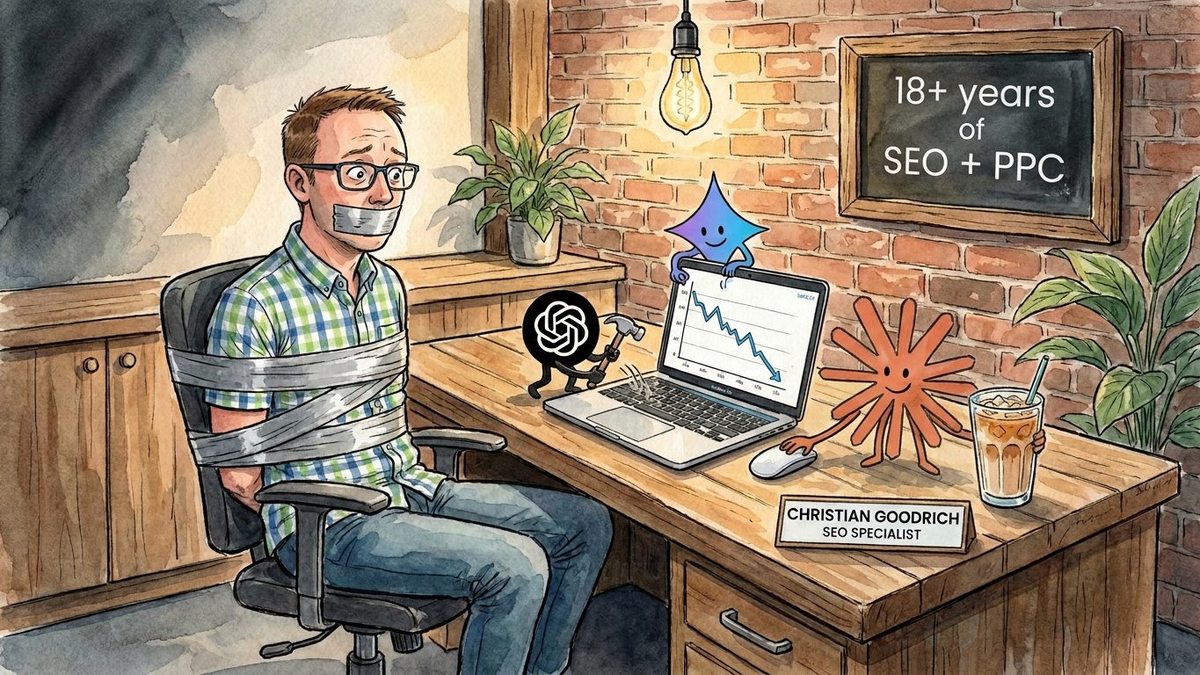
“Can’t we just use AI for our SEO instead?”
A business owner asked me that recently. I gave them an answer on the spot, but it stayed with me, so I put my data hat on and went back through four months of my own Claude Code transcripts to answer it properly.
For context, I’m not an AI sceptic. Claude Code runs analysis for me daily, builds my reporting, drafts alongside me and processes more data in an afternoon than I could in a fortnight. It’s also the subject of my brightonSEO and MeasureFest talk, How Claude Code helped me transform reporting and delivery for AI search and SEO. So my caution isn’t about whether to use AI, but who’s using it and how deeply they know search. That’s the question brands should be asking when they wonder whether they can use AI for SEO instead of hiring a specialist or an agency, because the visibility behind their daily enquiries and revenue is what’s at stake.
This is about using AI to do your SEO. Being visible and recommended inside AI answers is a separate job, AI search optimisation, and I cover that in my AI search guides.
AI did the groundwork for this analysis, pulling and deduplicating every message from my transcripts and flagging likely corrections, and I reviewed every flagged one by hand.
It turns out I’ve corrected AI more than 487 times.
The corrections in context
On its own that number doesn’t mean much, so here’s the breakdown.
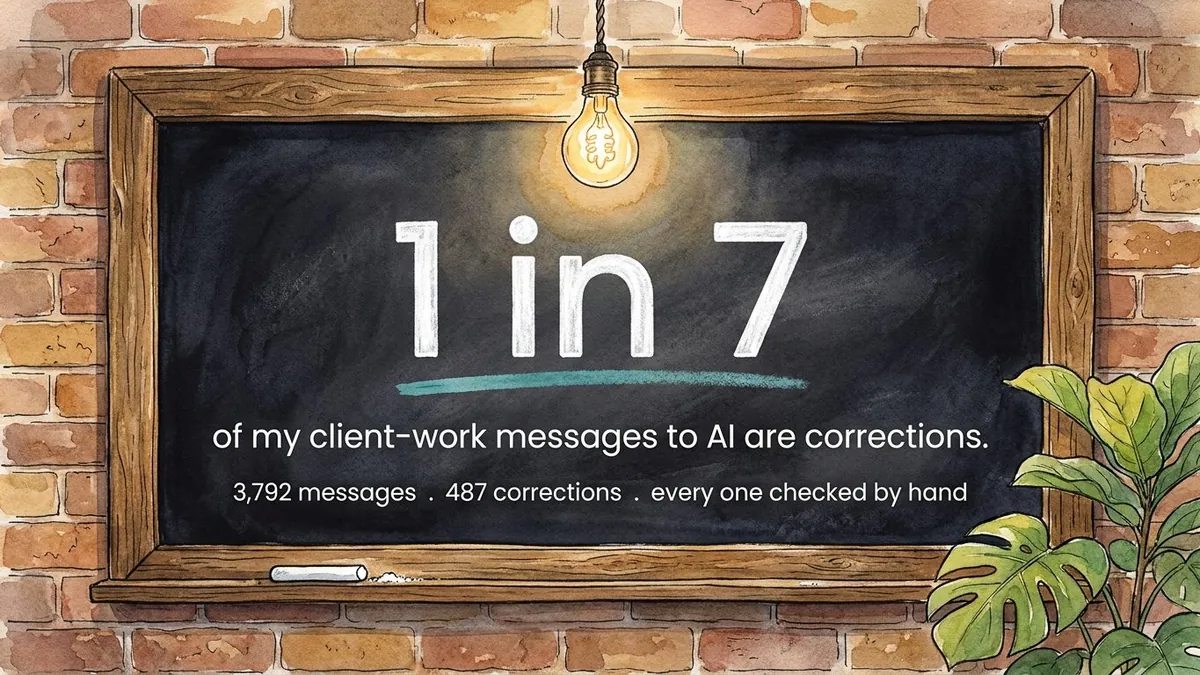
Across my client work, that’s one in every seven messages, and one in almost eight across everything I counted: 487 from 3,792 messages. That’s 12.8%, each one a correction or a challenge to something AI had answered with, and averaged out it’s three to five corrections every working day, from someone who prompts these tools for a living.
How I counted
The 487 corrections come from 3,792 messages I sent Claude Code over the four months up to late September 2026, across client work and my own projects, with every flagged message checked by hand. A correction means I told the AI it was wrong, or challenged something it had produced. The 12.8% is the share across everything; client work alone ran at one in seven.
And that count understates it. It only includes the corrections my search could detect, and it only covers Claude Code, which is about three quarters of my AI use.
I also cross-reference outputs between Claude and ChatGPT, partly because one model checking another catches things a single model won’t. And these errors weren’t coming from cheap tools. This was four months of daily work on a paid Max plan, running the most capable models available, Opus and Fable (rarely Sonnet or Haiku), at high effort settings. Not one correction came from a cut-down model or a free tier.
Now picture a brand running its SEO through the free version of ChatGPT, or a basic Claude plan that drops you onto a cheaper model. Less context and less reasoning sit behind every confident answer, so the correction rate runs higher, with fewer people equipped to notice.
The irony is that the first number this analysis produced was one in six. Reviewing it properly made it one in seven, almost eight, so even the statistic about correcting AI needed correcting.
What correcting Claude Code for SEO looks like
The most common opening words across those 487 messages, verbatim: “I don’t like”, “I don’t want”, “Try again”, “I don’t think”, “No, keep it”, “Are you sure”, and on seven occasions, “no em dashes”, despite strict instructions in my project files never to use them. If you’ve worked with AI at any depth, you’ve typed most of these yourself.
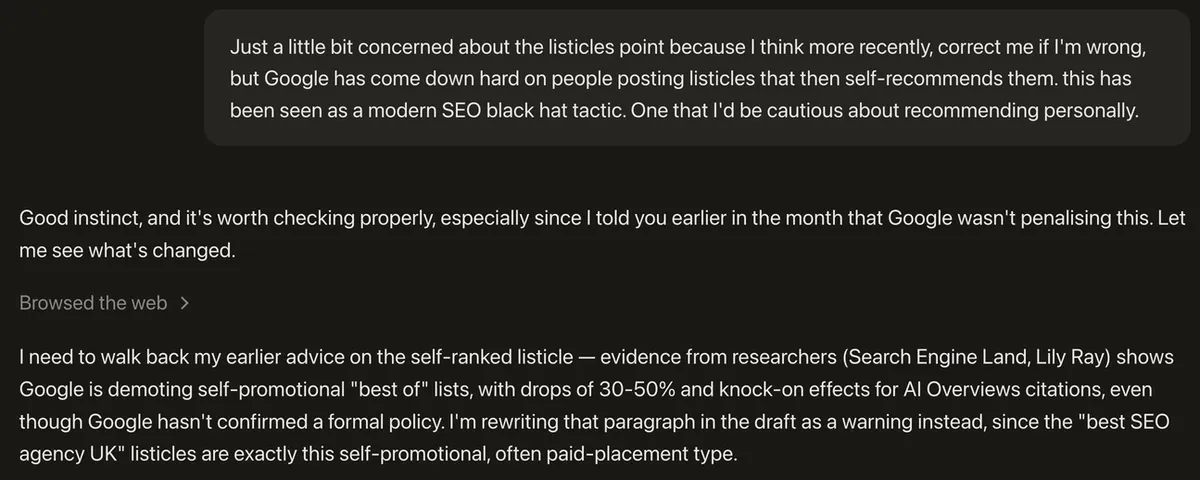
Behind those openers, a few real examples from recent weeks:
- A statistic with the wrong scope. A draft cited AI traffic to US retail sites up 760% year on year across the 2025 holiday season. The primary source’s full-season figure was 693%; the 760% covered only the first month. It sounded right, and anyone who checked would have caught it. AI is known for citing pages that don’t exist, or attributing a quote to a page that doesn’t contain it, so you have to be careful when you lean on it to source citations.
- Two client results merged into one. A draft combined a portfolio-wide return on search investment with one retailer’s AI visibility lift, presented as a single brand’s outcome. It read brilliantly and misrepresented the data.
- A client case study with an accidental insult in it. A draft described a retailer’s December re-platforming as happening at “the worst possible moment to touch anything”. For most of e-commerce that would be true, but this client’s December is their quietest month of the year, which is exactly why we agreed it with them. AI criticised a decision agreed with the client, in a deck we almost shared with them.
None of these reached a client, a page or an inbox, and that’s rather the point. Catching them is where expertise and discernment come in.
Why this keeps happening
AI produces the most plausible answer, and plausible isn’t the same as right. It doesn’t know your margins, which of two similar claims your client would sign off, how a sentence reads to someone inside the story, or which statistic an expert audience will check.
Hand the same tools to someone who doesn’t know search and the errors go unchallenged. Everything looks confident and nothing gets caught, because catching it means knowing what wrong looks like. At that point, anyone leaning on AI for SEO is flying blind, with full trust in a tool whose answers are only as good as the context it was given.
When a brand asks me whether they can just use AI for their SEO, I’ve started putting the question straight back: could I use AI to do what you do, instead of hiring you? It prompts a pause, because nobody says “yes” about their own trade. Most of the brands asking have already watched AI change how their own customers reach them, so they know where their value sits once the tools are everywhere: the judgement, the authenticity, and the accountability when something goes wrong. SEO is no different.
If I’m correcting AI several times a day with 18+ years of context to draw on, the question for a brand handing its SEO to AI and someone junior or non-specialist is simple: who’s catching their one in seven?
Does Google penalise AI content?
Not for being AI. Google’s line is that it rewards the finished quality of content, however it was produced. What it penalises is AI used to churn out pages without adding value, which its spam policies now name as scaled content abuse.
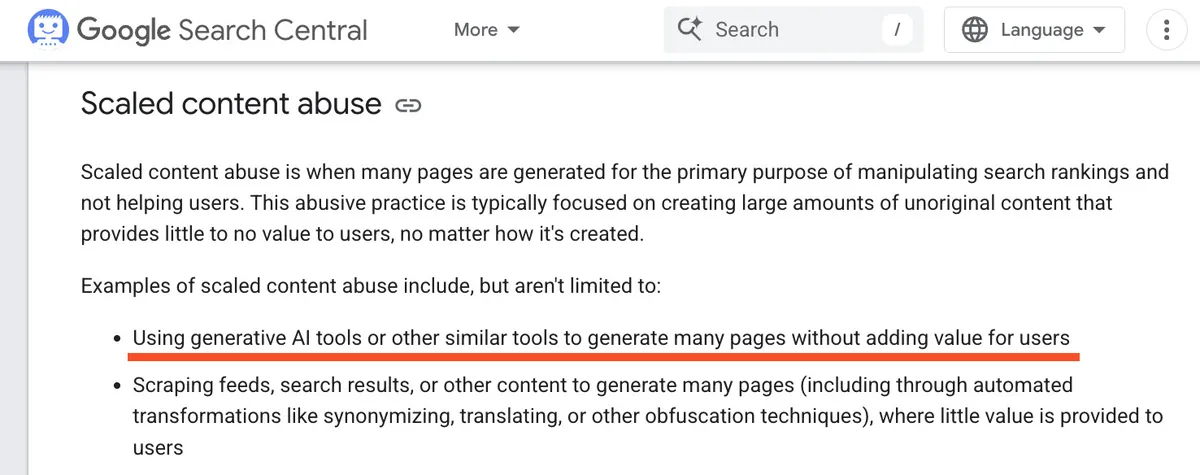
That’s where the risk sits. Some search mistakes are merely slow to reverse, but a few, a spam penalty, a burned domain, a deindexed site, are close to unrecoverable, and you only find out after the damage is done. Recovery can take weeks or months, with no guarantee it ever fully comes back.
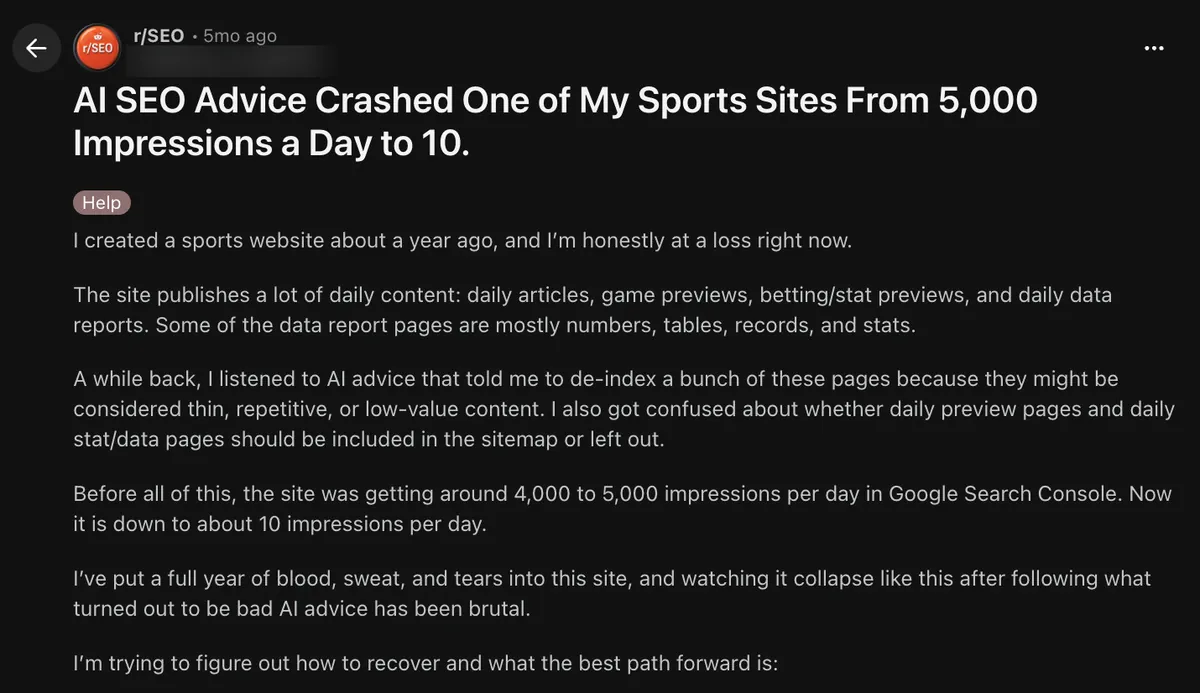
You don’t have to look far for real examples. A thread on r/SEO this year was titled “AI SEO Advice Crashed One of My Sports Sites From 5,000 Impressions a Day to 10”, and it’s exactly what it sounds like: the owner followed AI’s recommendation to noindex a batch of pages it judged thin, and one small change took the site from around 5,000 impressions a day to about 10.
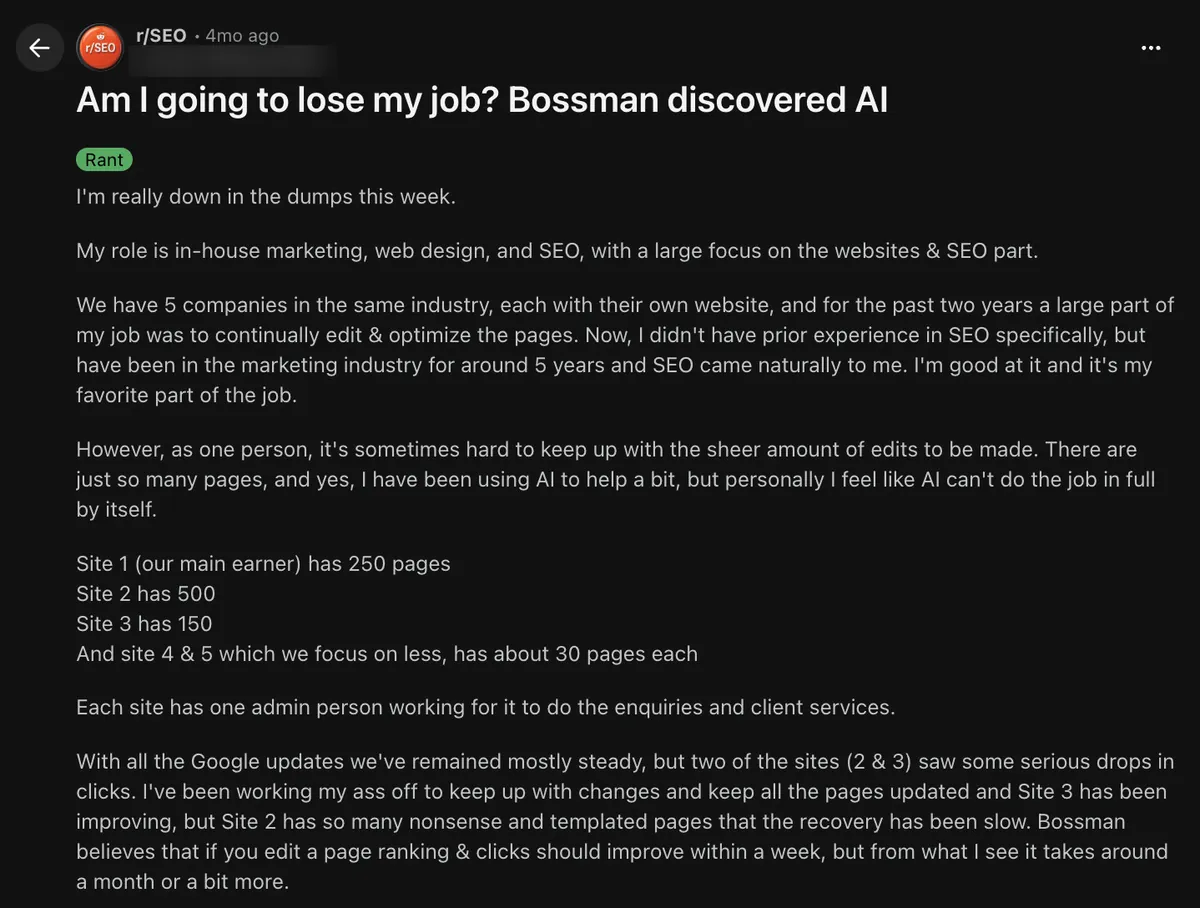
It isn’t a one-off. In another r/SEO thread, an in-house specialist describes their boss’s new AI assistant producing an instruction that would have blocked search engines from the entire site through robots.txt, stopped only because someone who knew better said no.
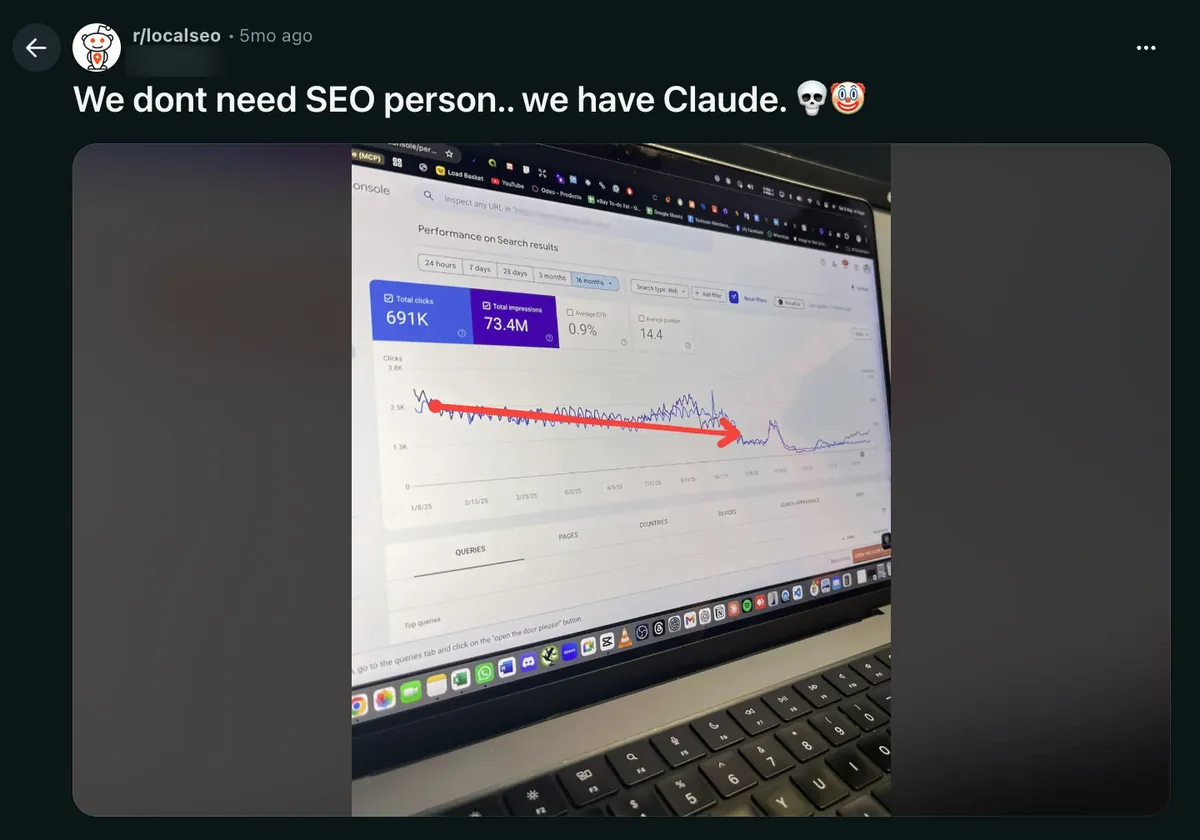
Over on r/localseo, a thread titled “We dont need SEO person.. we have Claude” is full of practitioners comparing notes on brands that tried exactly that.
I could list plenty more.
Knowing what to do next
Working with a brand on SEO was never mainly about the techniques: the technical audits, the page speed work, the refined meta titles. Those have their place, but they’re relatively easy to do, and easier still to dress up as an impressive-looking report. With AI and today’s tools, it’s never been easier to stay busy on search in ways that don’t move revenue.
What’s rare is knowing which one or two things, out of everything that could be done, will move the bottom line for your brand this month or this quarter, and leaving the rest alone. That takes a deep understanding of the business and its commercial goals, and years of knowing which levers do what, none of which arrives with the software. It’s also the thinking behind the name of my newsletter, Return on Search.
Is SEO dead? Nobody told the hiring market
One question settles this: if AI has replaced the SEO specialist, why is OpenAI hiring them? The company behind ChatGPT has advertised a content strategy role for its own site asking for “strong SEO and growth instincts” at up to $393,000 a year, plus a dedicated SEO and web strategy role.
The rest of the market is behaving the same way. In Semrush’s analysis of 3,900 US SEO job listings, 59% were senior roles, Director, VP and Head titles, at a median of $130,000, nearly double the rest. Nobody pays senior money for someone to drive a tool. Whether it’s an in-house head of SEO or an SEO consultant brought in from outside, those salaries buy the judgement behind it.
The part your competitors are getting wrong
A growing share of the brands I work with are competing against businesses that have leaned hard into unsupervised AI for SEO, and it shows: content with the same shape and phrasing as everyone else’s, claims that don’t hold up, and pages that look like advice with nothing underneath.
For the brands I work with, that’s been an opportunity, because expertise with AI behind it moves faster than expertise alone, and considerably faster than AI alone. I’m not the only one seeing it. There’s a question doing the rounds on LinkedIn, from hands-on SEOs to commercial leaders, that brands should sit with: when every result on page one was made with AI, who wins?
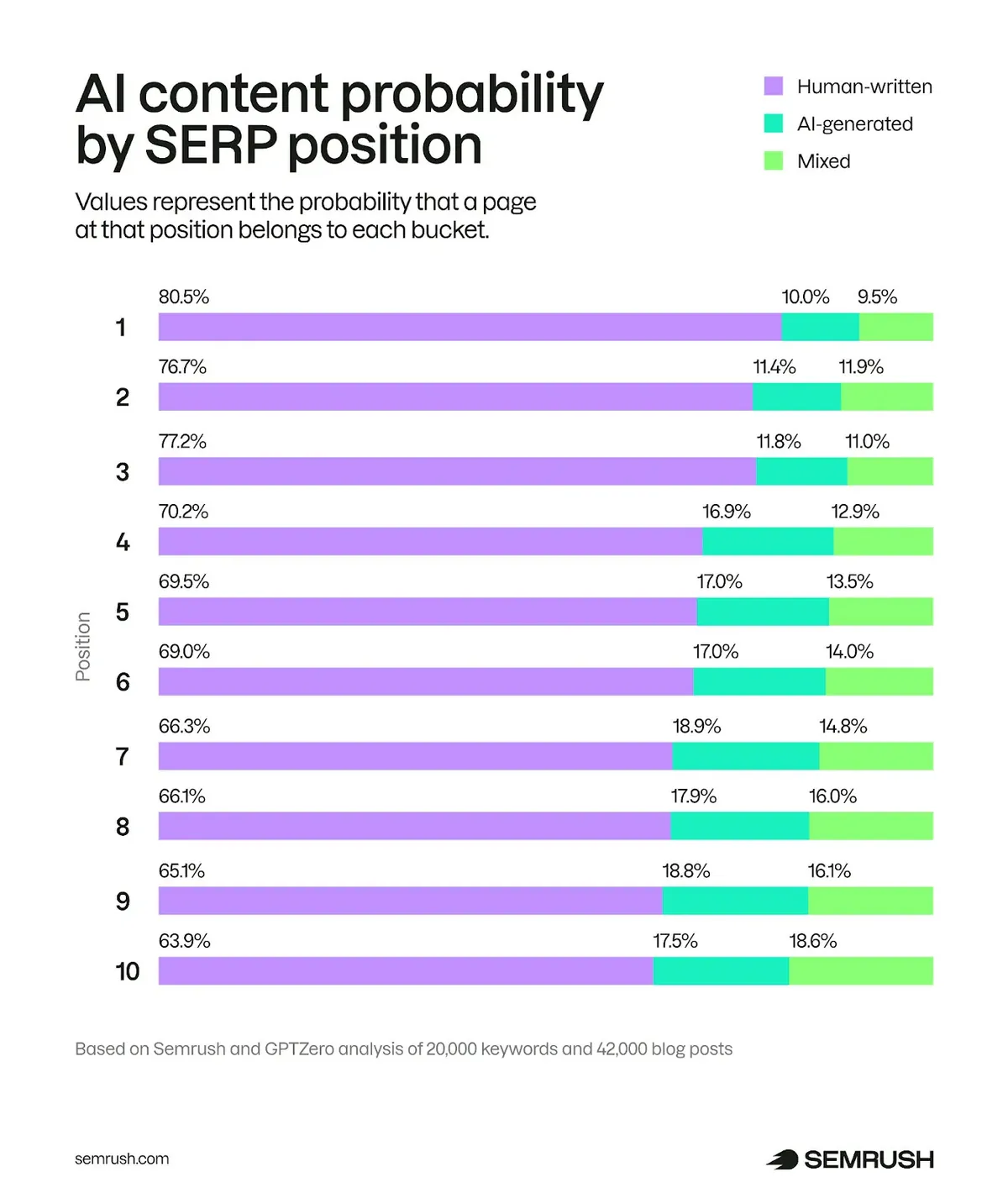
Semrush ran 42,000 blog posts through an AI detector earlier this year, and pages holding position one were eight times more likely to be classified as human-written than AI-generated. A detector can only judge how the writing reads, and that’s the real takeaway: content that’s obviously AI in its phrasing and quality sinks, while content that reads to a human standard rises, whether or not AI helped produce it.
So how well AI for SEO goes, and the risk that comes with it, depends heavily on the person driving it every day. If a specialist with 18+ years’ experience, on a paid subscription and the most capable models, still runs a 12.8% correction rate, what does that look like in the hands of someone who doesn’t know SEO?
Once everyone has AI, it stops being an advantage and becomes the norm, and Google can’t rank everyone first. Your customers are learning to tell generated from earned, and increasingly AI answers and search algorithms are too.
You can get passable output from AI in minutes, but passable is now the most crowded position in search. What the tool can’t give you is the judgement that decides what will hold up, what will stand out and what would embarrass you. What separates brands is everything the tools can’t generate: first-hand experience, original data, real customer evidence, a reputation third parties cite, and someone who can tell when the confident answer is wrong. All of that is human, and AI decides how fast you act on it.
So, can you use AI for SEO instead of an SEO specialist?
If a brand wants to gamble its visibility on AI without a reputable SEO specialist behind it, crack on. Your competitors and I will be grateful.
I correct AI every working day, several times a day, and it makes me faster, not redundant. If the person behind the prompt for your brand can’t tell when the confident answer is wrong, the savings will end up costing you.
The brands I expect to be winning over the next 12 months are the ones treating AI as the accelerator behind someone who knows the terrain.
This article first appeared as an edition of my Return on Search newsletter on LinkedIn.