
“How do we know if AI search is working?”
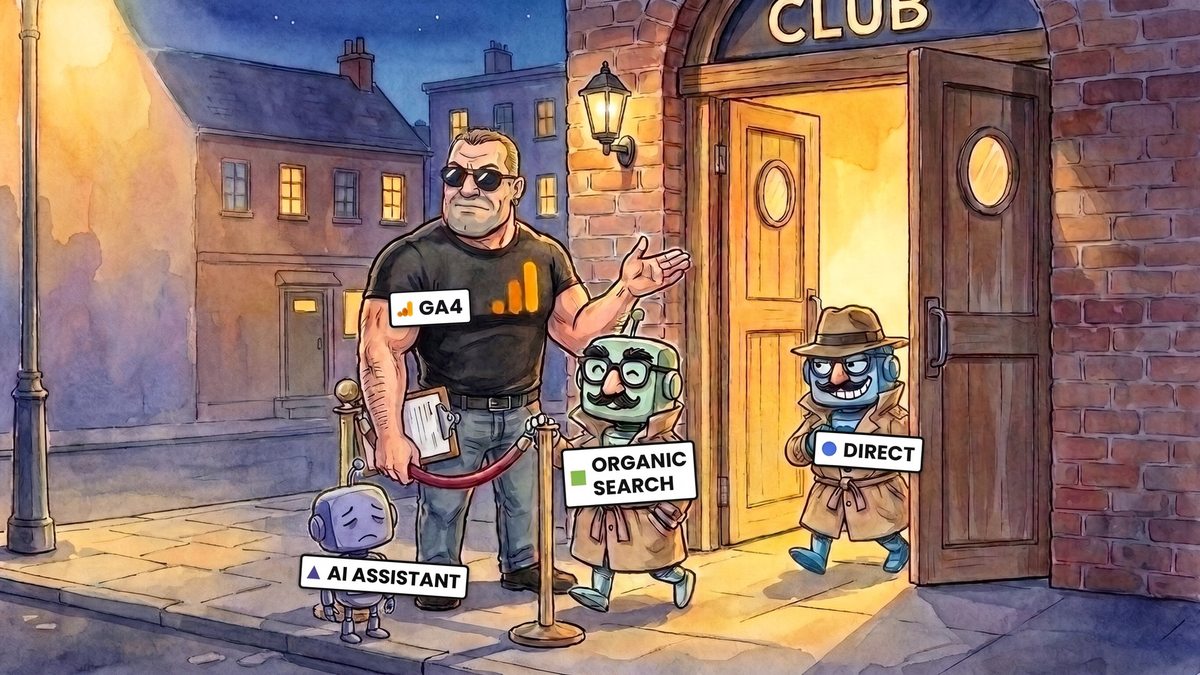
That was the question I heard more than any other at eCommerce Expo in September, usually straight after “how do we get our products into AI answers?”. For most brands the first place to look is GA4, and GA4 now has an answer ready: a channel called AI Assistant.
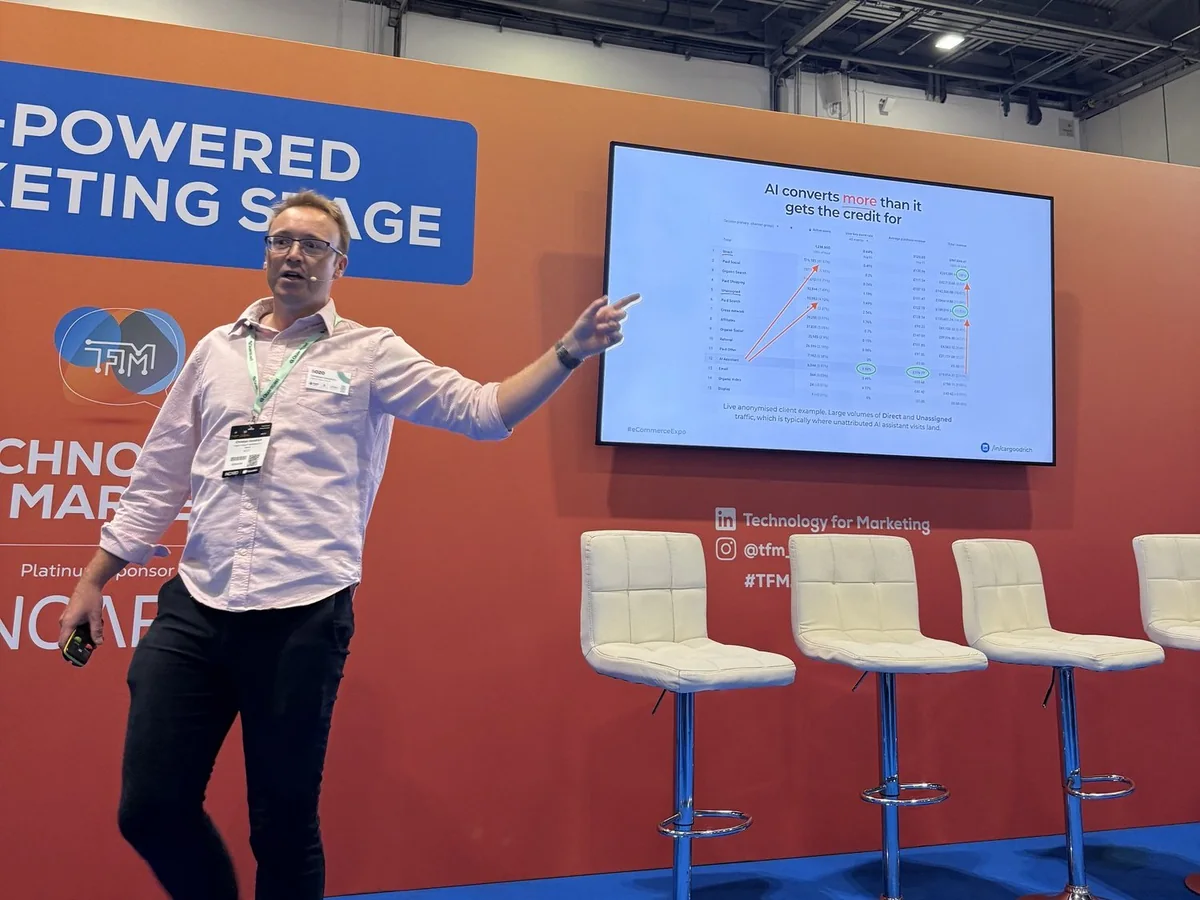
One of my slides that day argued that Direct and Unassigned traffic could be where unattributed AI visits land, and I’d made a similar case in July when I wrote that AI sends you almost no traffic, but is worth more than everything else you’re measuring. So I went back through our client data at SOZO to test that properly … and the answer wasn’t the one I expected.
What it did show is more useful, and more uncomfortable for anyone setting search budgets from GA4.
Does GA4 track AI traffic?
Partly. GA4 now has a channel for it, called AI Assistant, which counts the visits it can attribute to ChatGPT, Gemini, Perplexity and similar tools. Across 41 of our client GA4 accounts, the median account recorded 0.57% of its sessions through it between July and September 2026, and 29 of the 41 were under 1%. In these accounts the channel only started recording traffic in May 2026; before that, the same visits sat under Referral, which is worth knowing before you compare this year with last.
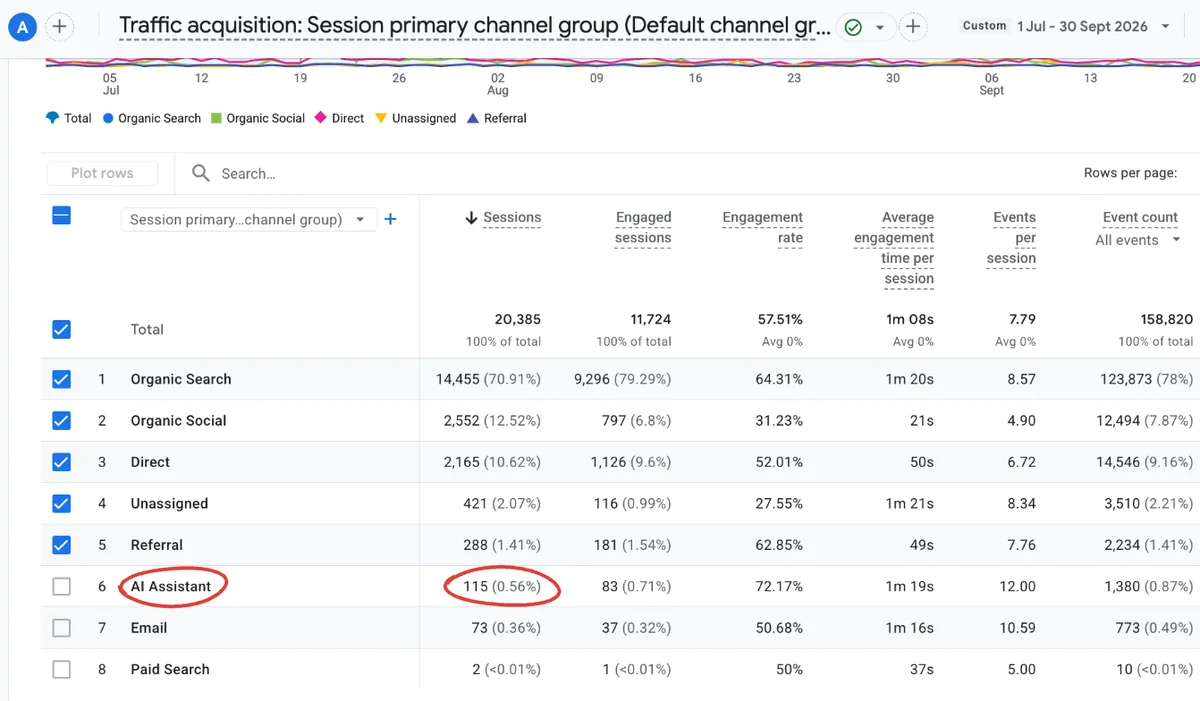
Taken at face value, that makes AI search a rounding error you might feel inclined to leave out of your marketing strategy. For some businesses that reading will prove expensive, because their customers are using AI more than ever: Ofcom reports that 54% of UK adults now use AI tools such as ChatGPT, Copilot or Gemini, rising to 79% of 16 to 24-year-olds.
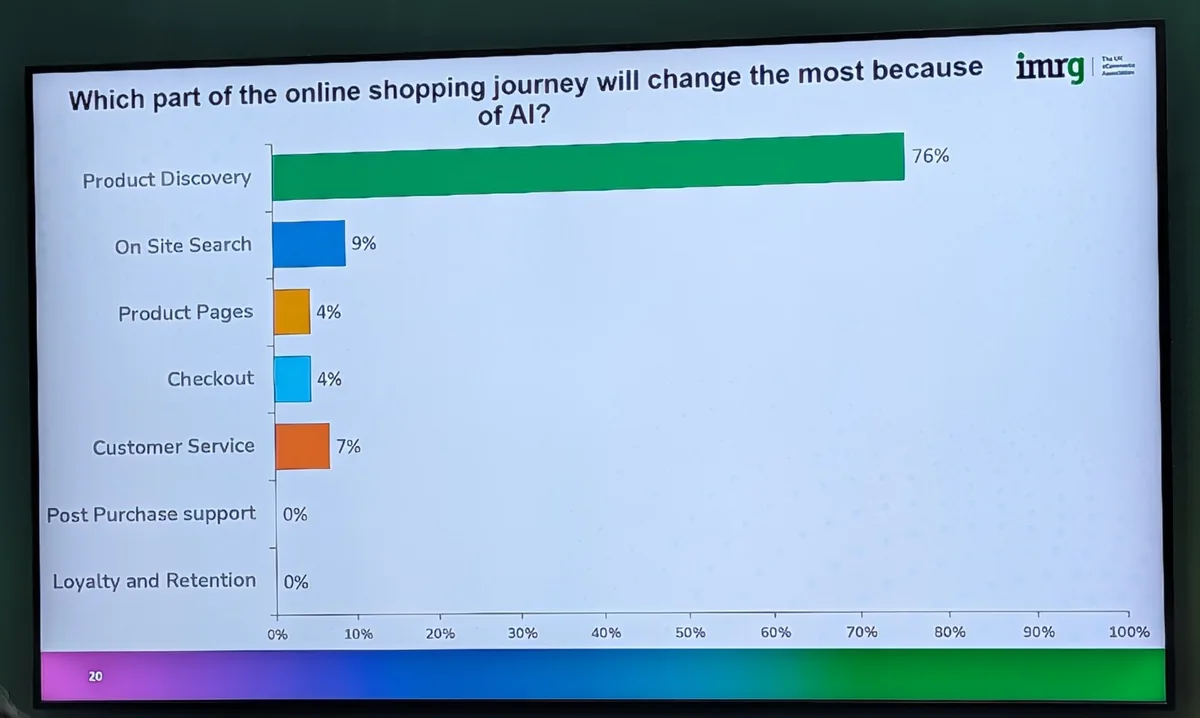
Retailers know it too. At the same Expo, IMRG’s Director of Data & Retail, Matthew Walsh, shared survey data in which 76% picked product discovery as the part of the online shopping journey AI will change the most.
Why AI answers rarely send the click
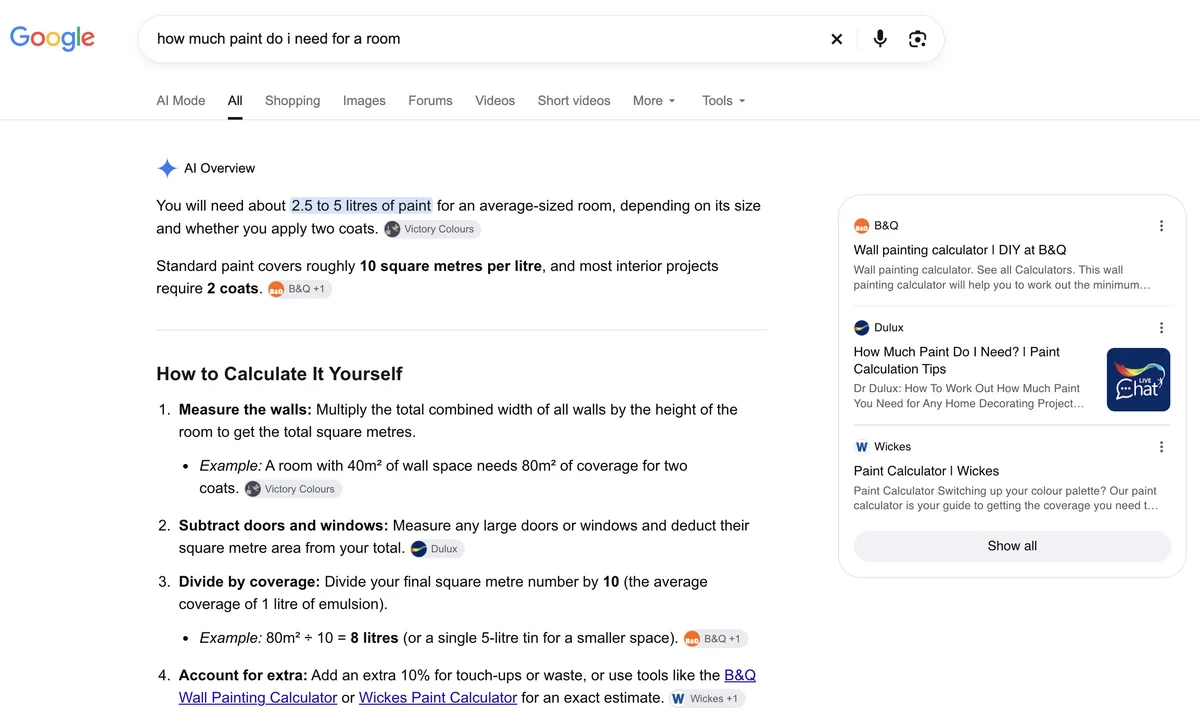
AI assistants answer inside the conversation, which makes most of AI search zero-click by design. A brand can be named, compared and recommended, and the route to its website is often a small citation that barely looks like a link.
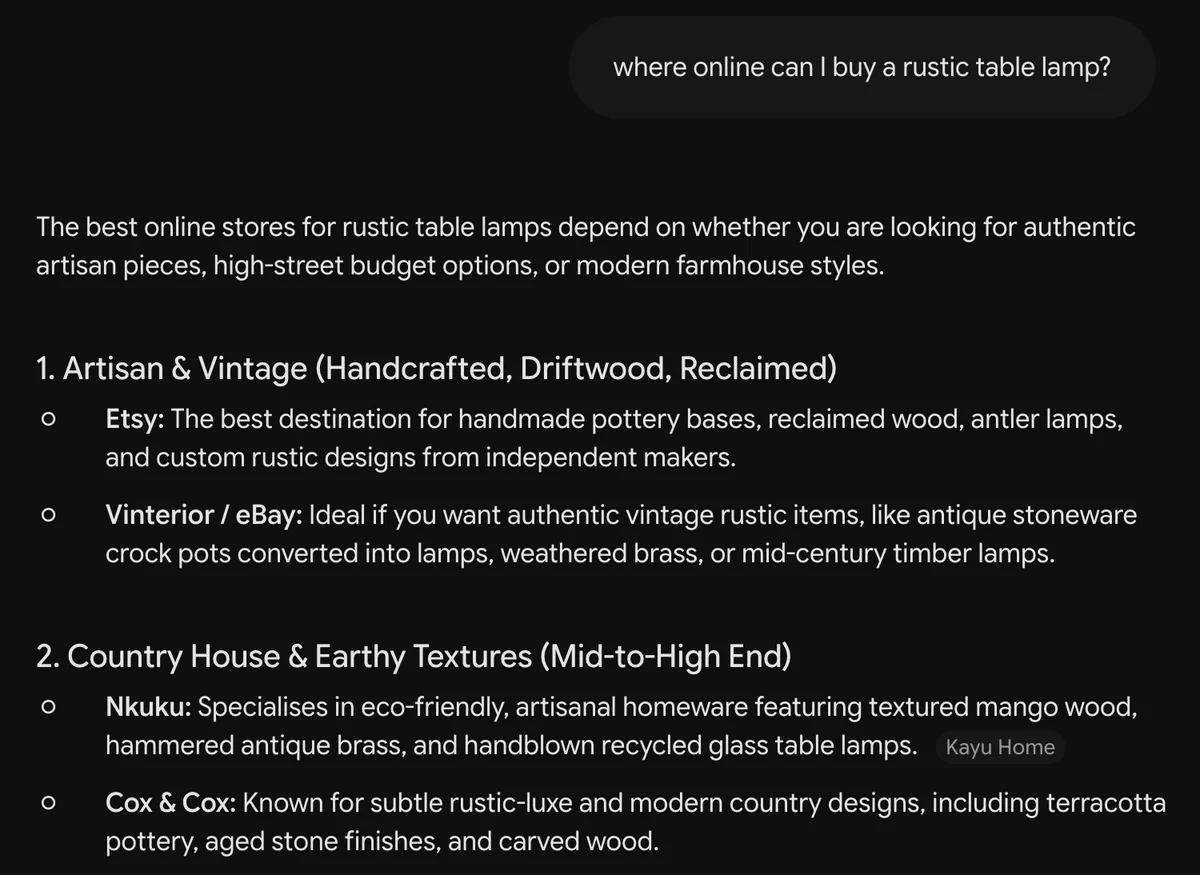
When I asked Gemini where online I could buy a rustic table lamp, it recommended Etsy, Vinterior, eBay, Nkuku and Cox & Cox, and none of them got an obvious link. The only citation in view was a small grey chip beside Nkuku, and it carried a different shop’s name altogether.
It isn’t consistent either. When I asked ChatGPT, Gemini and Google’s AI Mode where to buy curtain and upholstery fabric online on 20th October, I got three different shortlists, and only ChatGPT named the fabric retailer we work with. Answers change between runs and between users, so a single check on a single platform tells you very little.
Pew Research Center tracked the searches of 900 US adults and found they clicked a traditional result on 8% of visits that showed an AI summary, against 15% of visits without one, and clicked a source cited inside the summary on 1%.
Informational searches take the biggest hit, because those are the questions AI answers in full. Across our clients, clicks to blog posts, guides and help pages fell 15% at the median site, against 9% for product and service pages. For one lead gen client, a history article went from 135 clicks a quarter to 15.
Where AI’s influence shows up instead
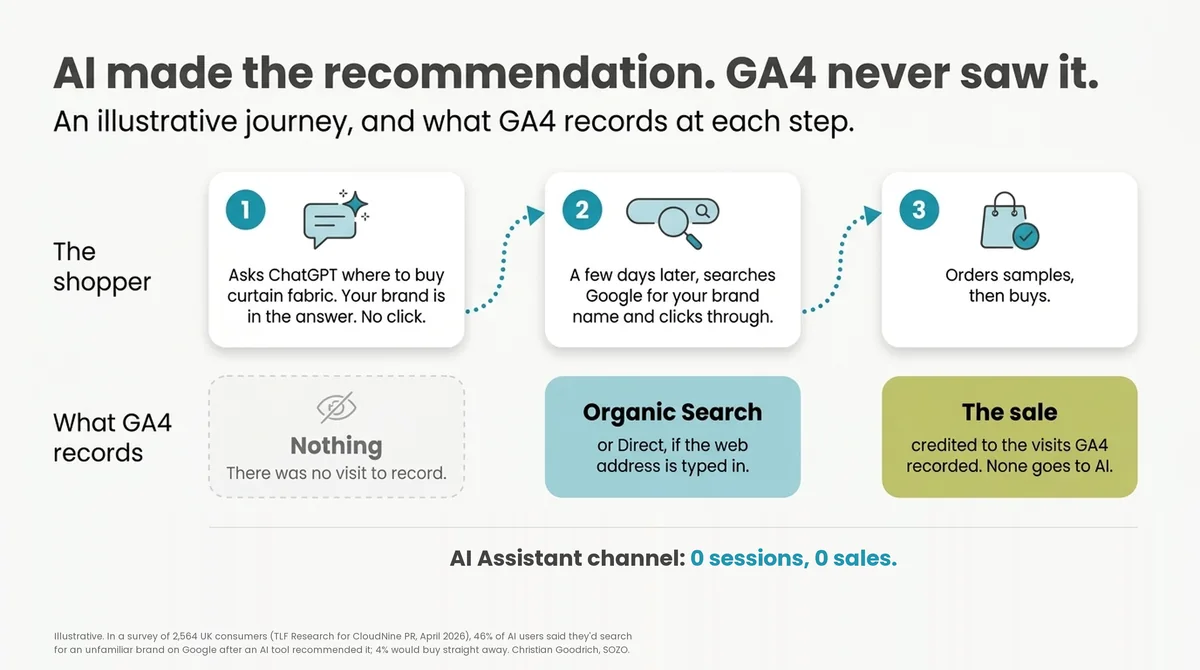
Seeing a brand in an AI answer still changes what people do next. In a survey of 2,564 UK consumers by TLF Research for PR agency CloudNine, 46% of the AI users said they’d search for a brand they didn’t know on Google or another search engine after an AI tool recommended it, and 32% would visit its website. Only 4% would buy straight away.
GA4 files each of those visits under another channel. A Google search for your brand name is Organic Search, and typing your address is Direct. Neither is credited to AI.
Search Console data from 36 of our client sites fits that pattern. At the median site, brand clicks rose 6% and non-brand clicks fell 31%, and non-brand fell faster at 29 of the 36.
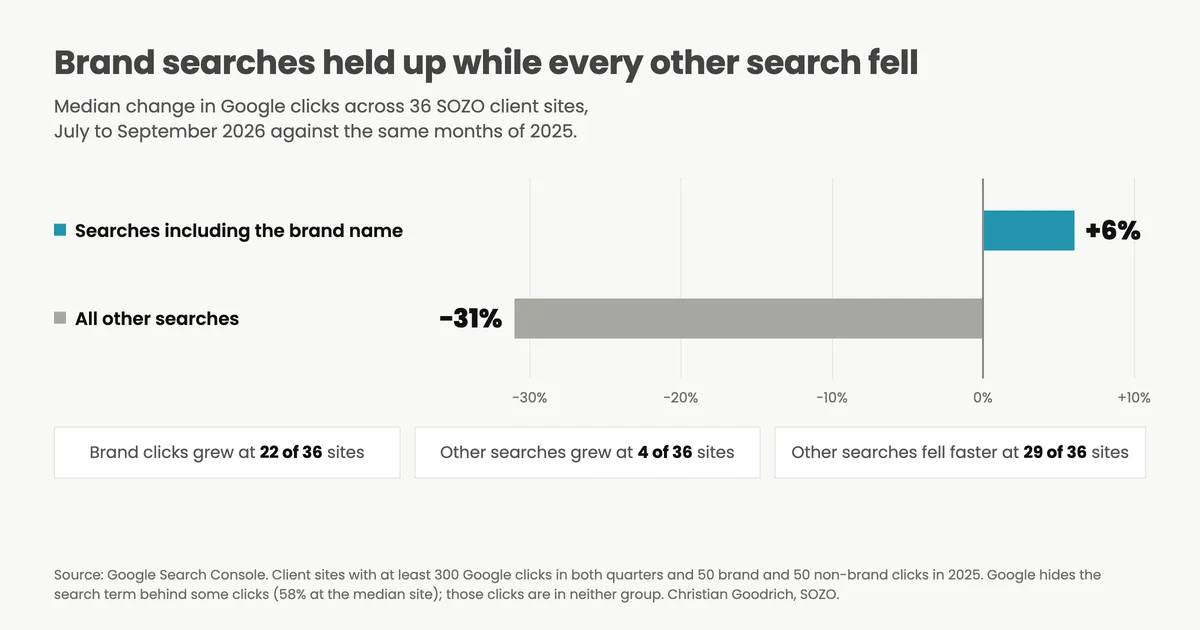
One lead gen client lost 20% of their Google clicks this summer, while clicks from searches for their name rose 44%. Search Console can’t tell you what prompted a brand search, so this doesn’t prove AI caused it, but it does show discovery happening somewhere analytics can’t see.
People rarely act on an AI recommendation alone: in that UK survey, 79% said they’d check other sources first. GA4 only records visits to your site, if consent lets it, and its data-driven attribution shares the credit for a sale between those visits. An AI answer that never sent a click isn’t one of them, so it gets none of the credit.
What is ‘Direct’ traffic in Google Analytics?
Miscellaneous, mostly. Direct is where GA4 puts every visit it can’t trace to a source: typed addresses and bookmarks, but also links from apps, email and messaging, AI apps that don’t pass on where the visitor came from, bots, and visits whose source was lost to cookie consent or ad blockers. On one client site, bots alone added around 150,000 Direct sessions in a single month. Unassigned is its neighbour, for visits GA4 has some source data on but can’t match to any of its channel rules.
So when Direct makes up a big share of a site’s visits, nobody believes that many people are typing a web address in by hand in 2026, and the fair question is what’s in there.
If AI visits were piling into Direct, you’d expect Direct to rise as organic clicks fell. It didn’t. Across 33 client accounts without known tracking faults, Direct rose 1% at the median while organic search fell 20%. The mechanism behind my Expo slide is real, since some AI apps don’t pass on a referrer, but across our clients it’s nowhere near big enough to explain the clicks that went missing. GA4 can’t tell you where a growing share of your visits come from, and neither its AI Assistant channel nor Direct measures AI’s influence.
Do visitors from AI search convert better?
Often, and the ones who do click can be worth far more. The visitors who arrived from AI assistants converted better than organic visitors at every client site with enough volume to judge (July to September 2026):
- A specialist drinks retailer: 1.41% of AI visits ended in a purchase, against 0.58% from organic search
- A home cinema and audio retailer: 4.85% against 0.59%
- A fabric retailer: 2.97% against 2.00%
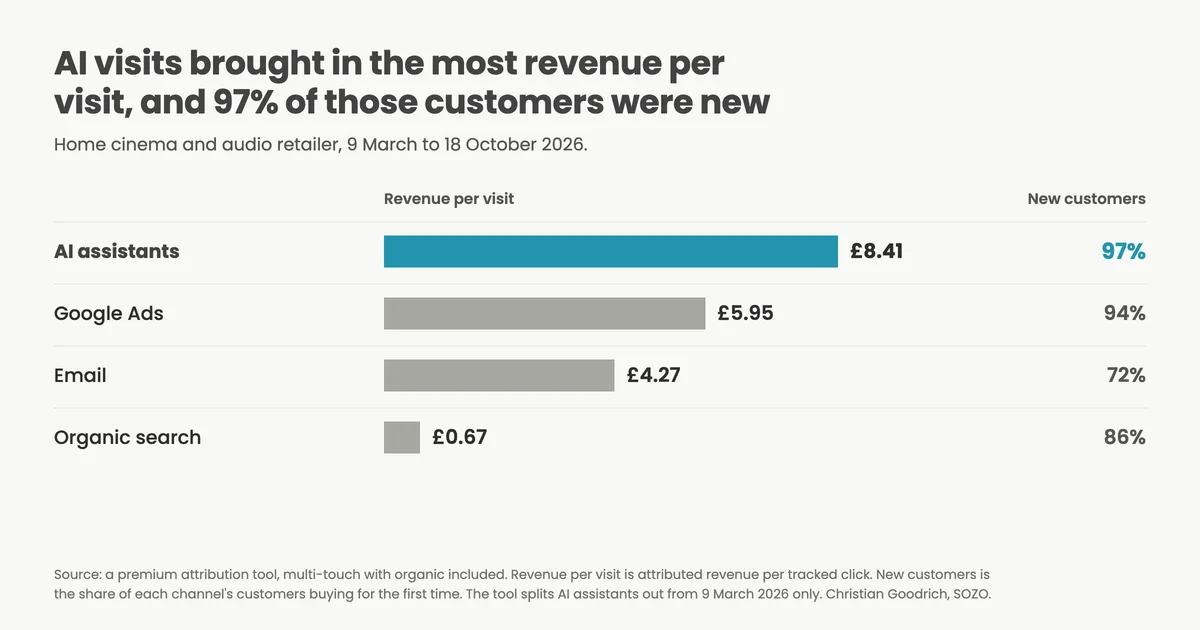
At the home cinema retailer, a premium multi-touch attribution tool tells the same story (March to October 2026): AI assistants returned £8.41 per visit, against £5.95 for Google Ads and £0.67 for organic search, and 97% of those AI customers were new to the brand.
That isn’t true everywhere, though. IMRG’s benchmark from 120 retailers, which Matthew Walsh also shared at the Expo, tells a more modest story: across the market, traffic from AI assistants converted at 2.3%, barely above organic search at 2.2%, with a huge spread between retailers, from almost nothing to well into double figures. So AI visitors can be worth far more, but it depends on the retailer, which is one more reason to measure it rather than assume it.
They don’t necessarily spend more per order, mind. The drinks retailer is the only one where AI visitors’ baskets were bigger, and that’s new this year, so I wouldn’t bank on it.
What GA4’s half a percent was hiding
Take the fabric retailer we work with. In GA4, AI assistants brought it 0.54% of its sessions between July and September, close to our median account and easy to write off.
Measured the way I’d want it measured, it looks very different. Against the same non-branded questions every month, its share of brand mentions among the competitors we track rose from 67% last September to 78% this September, and visits from AI assistants rose from 754 to 3,371 against the same months last year.
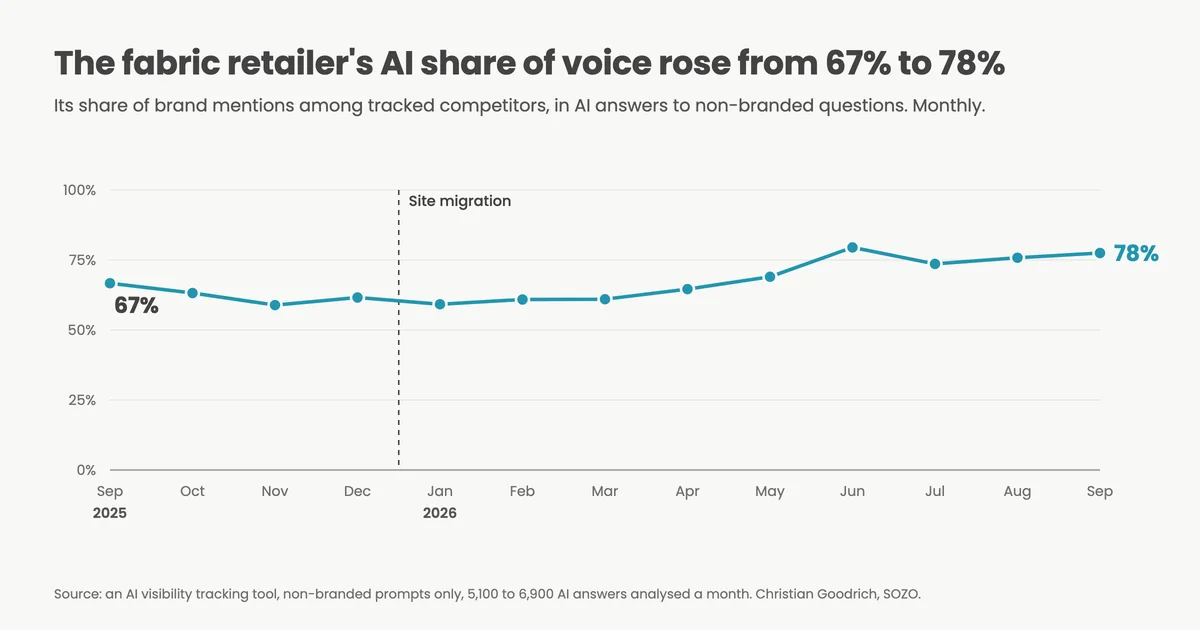
The work behind it was deliberate: when the site went through a migration, we set an AI visibility baseline before launch, prioritised the pages AI platforms were citing, and tracked sentiment either side. Figures moving together don’t prove cause, but it’s exactly the kind of progress a GA4 channel report would never show you.
Most brands aren’t in that position. Of the 59 brands we’ve audited since late September, the median was named in just 5.3% of AI answers to non-branded questions about its own category, and 12 weren’t named once (they asked for or were offered an audit, so it’s not a random sample). If GA4 is the only place you’re looking, you won’t know which of those you are.
The risk is cutting the wrong budget
Judged by its GA4 channel, AI search looks like half a percent of traffic, which makes it an easy line to cut, or one that never gets the investment or attention it needs in the first place. Judged by clicks, informational content looks like it’s failing, when its job is increasingly to be the source an AI answer draws on. Set search KPIs by GA4 channel and you risk moving budget away from AI search, or never putting it there, just as your customers move towards it.
How to measure AI search visibility instead
As Head of Search at SOZO, I’ve developed our AI visibility measurement and benchmarking, and built it into the reporting our clients see. These are the measures I’d want in front of anyone judging search:
- AI visibility: how often you’re named in AI answers to the non-branded questions your customers ask, measured the same way every month.
- Brand search clicks, reported separately and compared with the same months last year.
- Enquiries and sales counted where they arrive, in your CRM or store, with GA4 as the cross-check rather than the source of truth.
- “How did you hear about us?” on every enquiry form and after checkout, as a multi-select that includes ChatGPT or another AI assistant.
- Call tracking, because GA4 only records the click on a phone number.
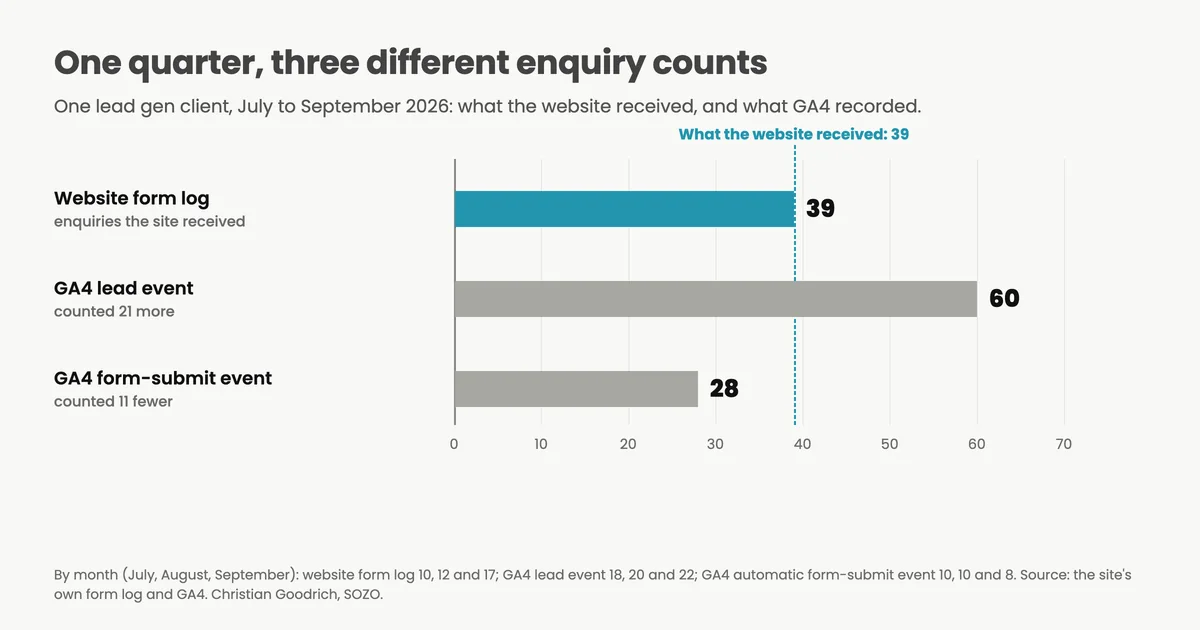
The enquiry count is where GA4 surprised me most. At one of our lead gen clients, GA4’s lead event counted 60 enquiries in a quarter when the website logged 39, while its automatic form-submit event counted 28, wrong in the other direction.
The multi-select is deliberate. Asked as a single dropdown, most people pick Google, because that’s where the visible part of the journey happened, whereas letting customers tick everything that played a part shows which channels they felt influenced them, a view no analytics tool gives you.
One catch: form logs get deleted. Neither of the lead gen clients I checked could give me a year-on-year enquiry count, because one log only goes back to May and another deletes entries after 91 days. It’s a sensible privacy setting, but the form plugin isn’t a long-term record, so what good looks like is every enquiry flowing into a CRM.
So, is your Google Analytics lying to you?
Not on purpose. It reports the visits it can see, and AI does its work where GA4 can’t look: in a conversation that names your brand, followed days (sometimes weeks) later by a Google search or a typed-in address that GA4 attributes to Organic Search or Direct.
Your customers are already asking AI who to buy from, and GA4 won’t tell you whether they heard your name. Judge AI search on half a percent of sessions if you like … just don’t be surprised when the brands they hear about aren’t yours.
The brands I expect to pull ahead over the next year are the ones measuring AI search by brand demand, AI visibility and the enquiries and sales they count at source, and investing on that basis, while their competitors wait for a GA4 channel to tell them it’s worth it.
This article first appeared as an edition of my Return on Search newsletter on LinkedIn.